
To measure your emotional quotient, use assessments like questionnaires or inventories that gauge your ability to recognize and understand your feelings. Incorporate self-awareness techniques such as daily journaling and mindfulness exercises to track your emotional responses over time. These tools provide clear benchmarks and insights into your strengths and areas for growth. By applying consistent evaluation methods, you’ll gain a better understanding of your emotional functioning and discover ways to improve—keep exploring to learn more about these practical strategies.
Key Takeaways
- Use formal assessments like questionnaires or inventories to gauge emotional recognition and understanding skills.
- Practice self-awareness techniques such as journaling and mindfulness to develop real-time emotional insight.
- Track emotional responses daily to identify patterns and areas for improvement.
- Compare assessment scores over time to measure growth and identify strengths or gaps in emotional intelligence.
- Combine formal tools with ongoing reflection to support continuous personal development in emotional functioning.
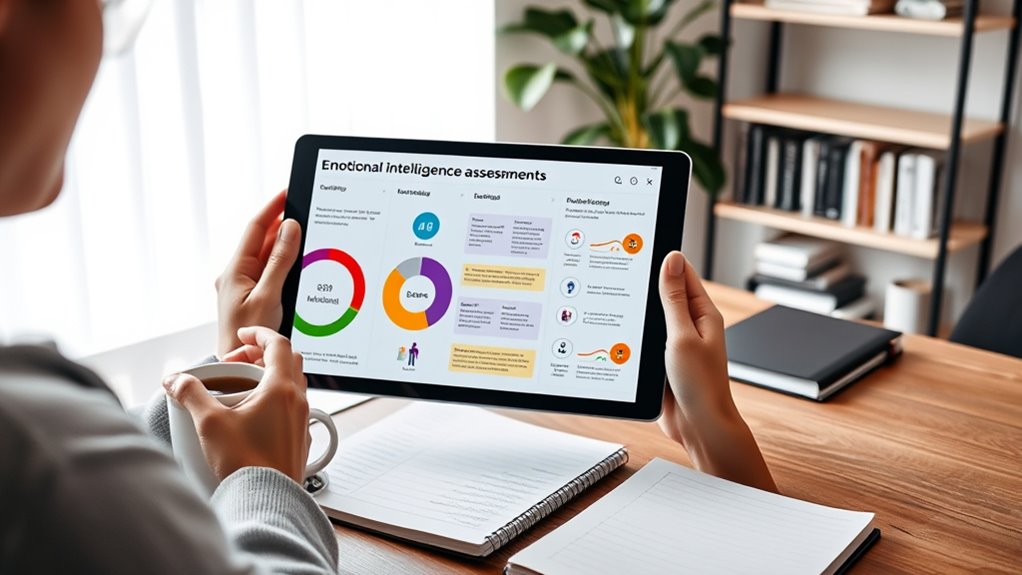
Have you ever wondered how emotional intelligence, or EQ, can be measured accurately? It’s a common question, especially when you’re trying to grow personally or professionally. To get a clear picture, many turn to various assessments and tools designed to evaluate different aspects of EQ. These assessments often rely on emotional intelligence benchmarks, which serve as standards to compare your responses and behaviors against established norms. By understanding these benchmarks, you can identify your strengths and areas needing improvement, helping you focus your efforts more effectively.
One of the key steps in measuring your EQ involves self-awareness techniques. These methods encourage honest reflection and observation of your emotional responses, reactions, and patterns. For example, keeping a daily journal of your feelings and how you handle different situations can provide valuable insights. As you track your emotional experiences, you develop a clearer understanding of your typical responses, which can then be compared to recognized benchmarks. This approach makes it easier to spot patterns, such as tendencies to become easily overwhelmed or to suppress certain feelings, and to address them consciously.
Many formal assessments incorporate self-awareness techniques as part of their process. These often include questionnaires or inventories designed to gauge your ability to recognize your own emotions and understand their impact. When you complete these assessments, you’re asked to rate how often you experience certain feelings or how well you can identify them in various contexts. The results give you a score or profile that highlights your emotional intelligence strengths and gaps. This information is invaluable because it provides a tangible foundation for your personal development.
Formal assessments reveal your emotional strengths and gaps through questionnaires and self-rating tools.
Beyond standardized tests, you can also use practical self-awareness exercises to measure your EQ. Mindfulness meditation, for example, helps you become more attuned to your emotional states in real-time. Noticing your feelings without judgment allows you to build awareness and regulate your responses better. Over time, these self-awareness techniques help you develop a more accurate internal gauge of your emotional landscape, which complements formal assessments. Additionally, understanding the role of contrast ratio can enhance how you interpret your emotional responses by recognizing the depth and clarity of your feelings.
Ultimately, measuring your EQ isn’t just about scoring well on tests; it’s about gaining insight into your emotional functioning. By understanding your emotional intelligence benchmarks and applying self-awareness techniques, you set the stage for meaningful growth. You become better equipped to navigate relationships, handle stress, and make decisions that align with your true self. The process is ongoing, but with consistent effort, you’ll find that your emotional intelligence improves, leading to a more balanced and fulfilling life.

52 Essential Emotional Intelligence Training – Relationship Skills Card Game for Empathy, Trust Building Activities, Conversation Starters, Team Icebreaker Tools – by Harvard Researcher
Featured in Forbes, CNBC, Business Insider, PopSugar: Packed with effective language, skills, and strategies; improve personal and professional…
As an affiliate, we earn on qualifying purchases.
As an affiliate, we earn on qualifying purchases.
Frequently Asked Questions
Can EQ Improve Over Time With Training?
Yes, your emotional intelligence can improve over time with training. By actively practicing empathy development and building emotional resilience, you can enhance your ability to understand and manage your emotions and those of others. Consistent effort, reflection, and learning from experiences help strengthen your EQ. Over time, you’ll notice better communication, stronger relationships, and increased self-awareness, all contributing to personal growth and emotional well-being.
How Reliable Are Self-Report EQ Assessments?
Self-report EQ assessments can be helpful, but they’re limited by self-report biases and accuracy issues. You might overestimate or underestimate your emotional skills, affecting assessment validity. While these tools offer valuable insights, don’t rely solely on them. Combining self-reports with observer feedback and behavioral measures provides a more reliable picture of your emotional intelligence, helping you identify growth areas more effectively.
Are There Cultural Differences in EQ Measurement?
You might wonder if cultural bias affects EQ measurement, and it does. Cultural differences can skew assessment validity because emotional expressions and social norms vary across cultures. Some tools may not accurately capture EQ in diverse groups, risking misinterpretation. To make certain of fair evaluation, it’s essential to develop culturally sensitive assessments. Recognizing these differences helps you better understand your emotional intelligence within your cultural context, leading to more meaningful personal growth.
What Are Common Misconceptions About EQ Testing?
You might believe emotional intelligence myths, thinking EQ testing perfectly measures your abilities, but it’s not that simple. Many overlook EQ testing limitations, like cultural biases or self-report inaccuracies. These assessments can’t fully capture your nuanced emotional skills or growth potential. Remember, EQ is complex, and one test doesn’t define your emotional intelligence. Focus on continuous personal development rather than relying solely on scores to gauge your progress.
How Does EQ Correlate With Workplace Success?
Your emotional intelligence directly impacts your workplace success by enhancing your ability to navigate workplace dynamics. Higher emotional intelligence helps you communicate effectively, resolve conflicts, and build strong relationships. These skills foster teamwork and leadership, making you more adaptable and resilient. As a result, you’ll find it easier to achieve goals, gain trust, and advance in your career, demonstrating that emotional intelligence is a key factor in professional success.

The Emotional Intelligence Journal: A Guided Companion for Building Self-Awareness, Emotional Resilience, and Deeper Connections
As an affiliate, we earn on qualifying purchases.
As an affiliate, we earn on qualifying purchases.
Conclusion
As you continue your journey of measuring EQ, imagine yourself as a skilled navigator steering through a vast, ever-changing ocean of emotions. Each assessment acts as a lighthouse, guiding you toward deeper self-awareness and stronger connections. With every tool you use, you illuminate new shores of understanding. Embrace this voyage, knowing that your growing emotional intelligence is the compass that leads to personal growth and meaningful relationships ahead.

INSIDE THEN OUT Better Every Day Journal – Guided Daily Journal With 365 Pre-Dated Prompts for Self Love, Reflection, Growth, Gratitude, Discovery, Wellness, Healing, Self Help, and Mindfulness – Self Care Routine & Mental Health Gift for Women Men
Guided Daily Journal: 365 thoughtful prompts designed for self-love, reflection, and growth. Get to know yourself on a…
As an affiliate, we earn on qualifying purchases.
As an affiliate, we earn on qualifying purchases.

Emotional Vocabulary Journal
As an affiliate, we earn on qualifying purchases.
As an affiliate, we earn on qualifying purchases.