This checklist is for anyone putting together a practical hydration setup, from daily water carrying to keeping bottles clean and exploring electrolyte options. It covers a mix of everyday essentials and optional tools, with advice for readers who are comparing formats and fit.

Get health and wellness essentials delivered free with Prime
- Fast, free delivery on millions of items
- Prime Video, Amazon Music and more included
- Member-only deals all year
The sections follow the job each item does: carry water, add an electrolyte option, filter water, clean reusable bottles, and consider two tools that have no featured product pick. Each section explains what to consider before choosing and identifies where the listed pick may fit.
Use the checklist to match each item to your routine, bottle dimensions, and cleaning or storage needs. Read the advice-only sections as decision guides, and check product details for compatibility and dimensions before buying.
Insulated Water Bottle
A reusable bottle is the part of a hydration setup you interact with throughout the day, so its capacity, shape, and lid should suit where and how you carry it. The listed pick is the YETI Rambler 36 oz Stainless Steel Bottle with Chug Cap, Black. Consider whether its stated capacity works for your usual carry and refill routine, and whether the bottle’s overall dimensions fit your bag, cup holder, or preferred storage spot.
A common buying mistake is choosing by capacity alone. A larger bottle can be inconvenient to carry or clean if it does not fit your routine, while a lid style that feels easy to use at home may be awkward on the move. Check the product’s dimensions and cap details, and confirm that the opening and included cap meet your handling and cleaning preferences. If you plan to pair the bottle with a brush or other accessories, compare those dimensions as well.
Think through how you will transport it, where you will set it down, and whether you are comfortable with the bottle’s size when full. Fit and handling matter as much as the listed capacity when choosing an everyday bottle.
What to look for:
- Confirm bottle dimensions against your bag or storage space.
- Check that the chug cap style suits how you drink and carry the bottle.
- Consider whether 36 oz fits your refill routine.
- Review opening and cap details for your cleaning approach.
- Compare bottle dimensions with any accessories you plan to use.
YETI Rambler 36 oz Stainless Steel Bottle with Chug Cap, Black

This 36 oz vacuum-insulated stainless steel bottle has a leakproof Chug Cap with a TripleHaul Handle that opens with a half-twist for quick sipping. It is double-wall insulated, sweatproof, shatter resistant, and dishwasher safe.
Pros:
- Leakproof cap opens with a half-twist for quick sipping
- Double-wall vacuum insulation
- Sweatproof and shatter resistant
- Dishwasher safe
Cons:
- Availability can vary
Best for: People who want a 36 oz stainless steel bottle with a chug cap.
Not ideal for: Anyone who needs a smaller bottle or has tight storage constraints.
Bottom line: Choose this pick if its dimensions and chug cap fit your daily carrying and cleaning routine.
Electrolyte Powder Packets
Single-serve packets can make an electrolyte product easier to portion and carry than a larger container, but the flavor, serving format, and ingredient information should match your preferences. The listed pick is Sqwincher Qwik Stik, Sugar Free, Assorted Flavors, 0.11oz Packets, 200. Review the package details to understand the flavor assortment, packet size, and directions for mixing before deciding whether this format works for you.
A frequent mistake is assuming every packet is intended for the same amount of water or that every flavor will be equally appealing. Read the label for preparation directions and ingredient information, and check whether the packet format works with the bottle or shaker you use. If you prefer to try a flavor before keeping a large quantity on hand, consider how the listed assortment and package count align with that preference. Keep the product’s claims grounded in its label rather than treating it as a substitute for individualized guidance.
For routine use, think about where packets will be stored and how you will carry them without tearing or losing them. Directions and ingredients are the useful details to verify first; the sugar-free description and assorted flavors are part of the product name, not a guide to personal suitability.
What to look for:
- Read the label for mixing directions and serving details.
- Review ingredients and any personal dietary considerations.
- Check whether the assorted flavors suit your preferences.
- Confirm packet dimensions work with your storage or carry method.
- Match the preparation directions to the bottle or shaker you use.
Sqwincher Qwik Stik, Sugar Free, Assorted Flavors, 0.11oz Packets, 200 Count

This electrolyte mix comes in a variety pack of four flavors and is designed for quick hydration on the go. Each single-serve packet is sugar-free, low in calories, and dissolves rapidly in water, making it ideal for replenishing fluids during physical activity or heat exposure.
Pros:
- Convenient single-serve packets for on-the-go hydration
- Zero sugar and low calorie content
- Fast-dissolving for quick hydration
- Variety of flavors to suit different tastes
Cons:
- Contains artificial flavors
- Requires water for consumption
- Limited to 200 packets per purchase
Best for: People who prefer sugar-free assorted-flavor packets in individual portions.
Not ideal for: Anyone who wants one specific flavor or needs a different format.
Bottom line: Check the label and packet format to see whether this assortment fits your routine.
Water Filter Pitcher
A pitcher can make filtered water available in a shared kitchen or at home without requiring each person to carry a separate filter. The listed option is the Clearly Filtered Water Pitcher with Filter and 3 Replacement Filters. Before choosing, check its dimensions, capacity, and the maker’s instructions so you know whether it fits your refrigerator shelf, counter space, and household routine.
A common mistake is buying a pitcher based only on its filter claims or included replacement filters. Review the product information for filter replacement directions, compatibility, and any stated limitations, and make sure replacement filters can be identified for future use. Consider how often the pitcher will need refilling and whether its size is practical for the people using it. If refrigerator clearance is limited, measure the available space and compare it with the pitcher’s dimensions, including any room needed to handle the lid.
Also consider who will maintain it: a pitcher is only convenient when refilling and replacing the filter fit naturally into the household routine. Capacity and upkeep are practical selection points. Use the product’s documentation to understand what the filter is designed to address rather than assuming all pitchers have the same performance or compatibility.
What to look for:
- Measure refrigerator or counter space against pitcher dimensions.
- Check pitcher capacity against household use and refill habits.
- Review filter replacement instructions and compatibility.
- Confirm what the product documentation says the filter addresses.
- Consider access to replacement filters for ongoing use.
Clearly Filtered Water Pitcher with Filter and 3 Replacement Filters

This bundle includes a Clearly Filtered water pitcher, one filter, and three replacement filters. Its multi-stage filtration system targets more than 386 contaminants, and the BPA-free Tritan pitcher has an easy-fill lid and ergonomic handle.
Pros:
- Targets a wide range of contaminants, including fluoride, lead, PFAS, and microplastics
- Includes three replacement filters
- Long filter life of up to 100 gallons
- BPA-free Tritan pitcher with an ergonomic handle and easy-fill lid
Cons:
- Filters need replacement approximately every four months
- The description says the system targets contaminants but does not specify removal performance for each one
Best for: Households seeking a pitcher supplied with a filter and three replacements.
Not ideal for: People without room for a pitcher or who prefer another filtration format.
Bottom line: Confirm dimensions, filter details, and replacement compatibility before choosing.
Bottle Cleaning Brush
Reusable bottles and their lids can be awkward to clean by hand, so a brush set can help reach interior surfaces and smaller areas. The listed pick is the MR.SIGA 5 Pack Bottle Brush Cleaning Set with Storage Holder, White. Review the included brush shapes and dimensions to see whether they reach the bottles, caps, and other items you actually need to clean.
A common buying mistake is assuming that a multi-piece set will fit every bottle or lid. Compare brush length and head size with the opening and interior of your bottle, and check whether any narrower attachments are suitable for caps or hard-to-reach areas. Also consider where the holder will sit and whether the brushes can dry and be stored conveniently. Product photos and details can help identify the included pieces, but verify dimensions where fit is important.
Think about how the set will work alongside your bottle’s cleaning instructions. Some bottle materials or lids may have care guidance that affects which brush is appropriate, so consult the bottle maker’s directions. Brush fit and storage determine whether a set is useful in your kitchen; the number of pieces alone does not guarantee that its shapes suit your specific bottles.
What to look for:
- Compare brush length and head width with bottle openings.
- Check which brush shapes are included in the set.
- Confirm brushes can reach the lid and other parts you clean.
- Measure space for the storage holder.
- Follow the bottle maker’s care directions when selecting a brush.
MR.SIGA 5 Pack Bottle Brush Cleaning Set with Storage Holder, White
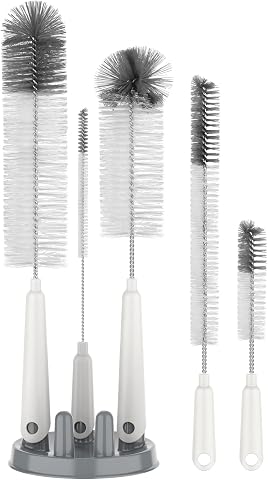
This set includes five differently shaped brushes designed for cleaning bottles, straws, and narrow spaces. Made with durable stainless steel and nylon bristles, they effectively clean glass, plastic, and metal bottles, including long-neck and wide-mouth bottles, with a convenient storage holder.
Pros:
- Includes multiple brushes suited for various cleaning tasks and bottle types
- Durable stainless steel and odorless nylon bristles provide effective cleaning without scratching
- Comes with a convenient storage holder to keep brushes organized
Cons:
- Some users may find the set unnecessary if only cleaning standard bottles
- Long brushes may be difficult to maneuver in very small openings
- Limited color options (white only)
Best for: People who want several brush shapes and a storage holder.
Not ideal for: Anyone whose bottle openings or care needs do not match the included brushes.
Bottom line: Check brush dimensions and bottle care instructions to confirm the set fits your cleaning routine.
Portable Water Quality Tester
A portable water quality tester is an optional tool for readers who want readings from water sources while away from home. No product is featured here, so use this section as a selection guide rather than a recommendation. Start by identifying what you want to measure and check whether a device reports those specific measures; the phrase “water quality” can cover different functions, and a general label alone does not tell you what a tester detects.
A common mistake is treating a reading as a complete assessment of water safety. Read the device documentation for its measurement range, operating instructions, calibration or maintenance needs, and stated limitations. Consider whether it is designed for the sample type and conditions you expect to encounter. Check the size and power requirements if portability matters, and confirm what accessories or consumables are needed before relying on the device as part of a routine.
Plan how you would interpret a result and what follow-up information would be needed. A tester is most useful when its documented capabilities match a clear question. Measurement scope is the key comparison point; avoid assuming that one handheld tool can identify every concern or replace authoritative guidance about a water source.
What to look for:
- Identify the specific measures you want the device to report.
- Review the documented range and stated limitations.
- Check instructions for sampling, calibration, and maintenance.
- Confirm the device supports the water sample type you expect to test.
- Consider size, power, and any required accessories.
Graduated Shaker Bottle
A graduated shaker bottle can help with measuring liquids or mixing a drink, depending on its markings, shape, and lid design. No product is featured in this slot, so compare options against the liquids and portions you expect to prepare. Look for clear measurement markings that cover the range you use, and check that the graduations are readable from the outside when the bottle is upright.
A common mistake is assuming that any marked bottle is accurate or easy to clean. Review the product details for units, measurement range, and care instructions, and look for a lid and opening that suit your mixing and washing routine. If you plan to use powder packets, check that the opening accommodates adding the contents and that the bottle’s capacity fits the preparation directions for the product. Do not infer compatibility from appearance alone.
Also consider how the bottle will travel when filled and whether its shape works with your bag or storage space. If a mixing mechanism is included, understand what it is and how it is cleaned. Markings, capacity, and care are the core comparison points; choose a design whose documented details suit your actual use rather than selecting by appearance alone.
What to look for:
- Check the measurement units and range on the graduations.
- Choose markings that are easy to read while upright.
- Confirm capacity suits the preparation directions you follow.
- Review lid, opening, and cleaning instructions.
- Compare dimensions with your bag and storage space.
If you are building your setup gradually, start with the item that addresses your most regular need: carrying water, filtering at home, or cleaning reusable bottles. Add electrolyte packets or an optional testing or shaker tool when their format and documented use match your routine. Check fit and instructions as you go so each addition works with the products you already use.
You do not need every category to make a useful checklist. Choose a few items that fit your space, habits, and preferences, and revisit the remaining sections when a specific need comes up. A setup built around practical everyday use is easier to maintain and adjust over time.