
TL;DR

Get health and wellness essentials delivered free with Prime
- Fast, free delivery on millions of items
- Prime Video, Amazon Music and more included
- Member-only deals all year
A 2025 Cochrane review pooling 30 studies and 1,720 participants found music therapy probably improves depressive symptoms in people with dementia and may improve overall behavior. It found little evidence of longer-term effects on cognition or agitation, and benefits may fade after sessions stop. Music is a supportive tool, not a treatment that reverses or stops dementia.
A 2025 update to a Cochrane review found that music therapy probably improves depressive symptoms in people with dementia and may improve overall behavior, while showing little evidence of lasting effects on cognition or agitation. The review, which pooled 30 studies involving 1,720 participants, supports music as a way to encourage comfort and engagement, not as a treatment that reverses or stops dementia.
The review’s findings offer a measured account of what music-based therapy may do. Most participants in the studies lived in care homes. The reviewers found that some benefits may not persist: effects may fade in the weeks after sessions stop. The findings do not establish that music changes the progression of dementia.
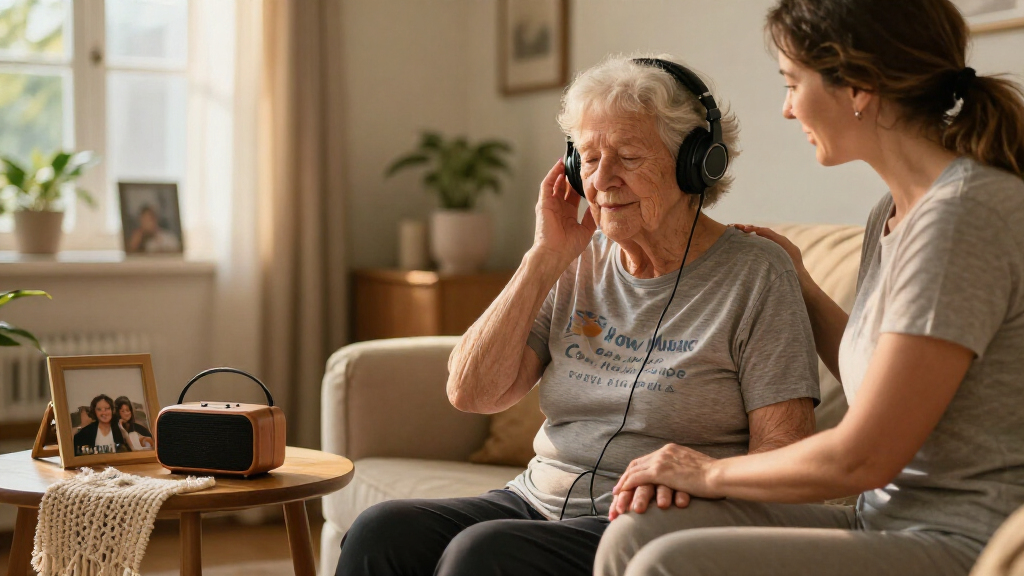
A separate study of 51 people with dementia at adult day health centers tested a personalized playlist delivered through headphones for 20 minutes. Researchers observed increases afterward in joy, eye contact, eye movement, engagement and talkativeness, and a decrease in sleeping. The reported results describe responses after listening; they do not establish lasting effects.
Music therapist Concetta Tomaino, executive director and co-founder of the Institute for Music and Neurologic Function, has described how some residents who appeared unresponsive sang along when she performed familiar songs. She said the experience prompted questions about how musical memories can remain accessible when other abilities are impaired. Researchers do not yet have a complete answer.
Music’s Role in Dementia Care
The findings matter to families and care workers looking for ways to support daily wellbeing. Familiar music may offer a practical way to prompt connection, engagement or comfort, including for someone who has difficulty communicating in other ways. The small day-center study suggests that a brief, personalized listening session can coincide with visible changes in engagement, though its results should not be treated as proof of a long-term benefit.
The review also draws a boundary around those possibilities. Music therapy is not shown to reverse dementia or reliably change cognition, and the evidence for longer-term effects on agitation was limited. Its potential value is in supporting a person’s experience in the moment and as part of care, rather than replacing medical treatment or other support.
comfortable over-ear headphones for seniors with dementia
As an affiliate, we earn on qualifying purchases.
As an affiliate, we earn on qualifying purchases.
Why Familiar Songs Can Persist
Music activates several brain systems involved in hearing, movement, memory and emotion. Listening engages the auditory cortex; moving with a song involves the cerebellum; and emotional responses involve areas including the amygdala. Enjoyable music can also activate the brain’s reward system, including pathways involving dopamine.
Tomaino has said that musical memories and attachments are embedded in deeper brain networks, which she described as more robust than some systems affected by dementia. That explanation is a clinical perspective, not a complete scientific account of why some people with dementia can sing a familiar song but cannot identify the person beside them. The evidence summarized in the review concerns music-based therapy and should not be read as proof that every person will respond in the same way.
“They not only came to life in the moment, but were able to sing the words.”
— Concetta Tomaino, executive director and co-founder of the Institute for Music and Neurologic Function
simple MP3 player for seniors with dementia
As an affiliate, we earn on qualifying purchases.
As an affiliate, we earn on qualifying purchases.
Limits of the Current Evidence
The review found little evidence that music therapy changes cognition or agitation over the longer term, and reported that some effects may diminish after sessions end. The supplied report does not provide details about the size of individual effects, how results varied across different types of dementia, or which approaches worked best for particular participants.
It is also unclear how consistently findings from studies conducted mostly in care homes apply to people living at home. The 51-person playlist study measured changes after a single 20-minute session; the reported information does not establish how long those changes lasted or whether repeated sessions produce durable effects. Responses to music can differ from person to person.
personalized music player for dementia care
As an affiliate, we earn on qualifying purchases.
As an affiliate, we earn on qualifying purchases.
Training and Further Research
Dr. Ihara said her team planned to develop an online training program for direct care workers in long-term care communities. The source material does not give a release date or say whether the training has since launched.
Further research will be needed to clarify how long observed benefits last, which music-based approaches are most useful, and how results differ across settings and participants. For now, the review supports a cautious conclusion: music may help with mood and engagement for some people with dementia, but it is not a disease-modifying treatment.
music therapy instruments for dementia activities
As an affiliate, we earn on qualifying purchases.
As an affiliate, we earn on qualifying purchases.
Key Questions
Can music therapy treat or reverse dementia?
No. The review does not show that music therapy reverses or stops dementia. It suggests possible benefits for depressive symptoms and overall behavior.
What did the 2025 Cochrane review find?
Across 30 studies and 1,720 participants, the review found that music therapy probably improves depressive symptoms and may improve overall behavior. It found little evidence of longer-term effects on cognition or agitation.
Did personalized playlists help participants?
In a study of 51 people with dementia, researchers observed increased joy, eye contact, eye movement, engagement and talkativeness after participants listened to a personalized playlist for 20 minutes. The report does not establish how long those changes lasted.
Do benefits continue after music sessions stop?
Not necessarily. The review noted that some effects may fade in the weeks after sessions stop; how long benefits last can vary and remains uncertain.
Source: rss
Halloween Picks
halloween
As an affiliate, we earn on qualifying purchases.