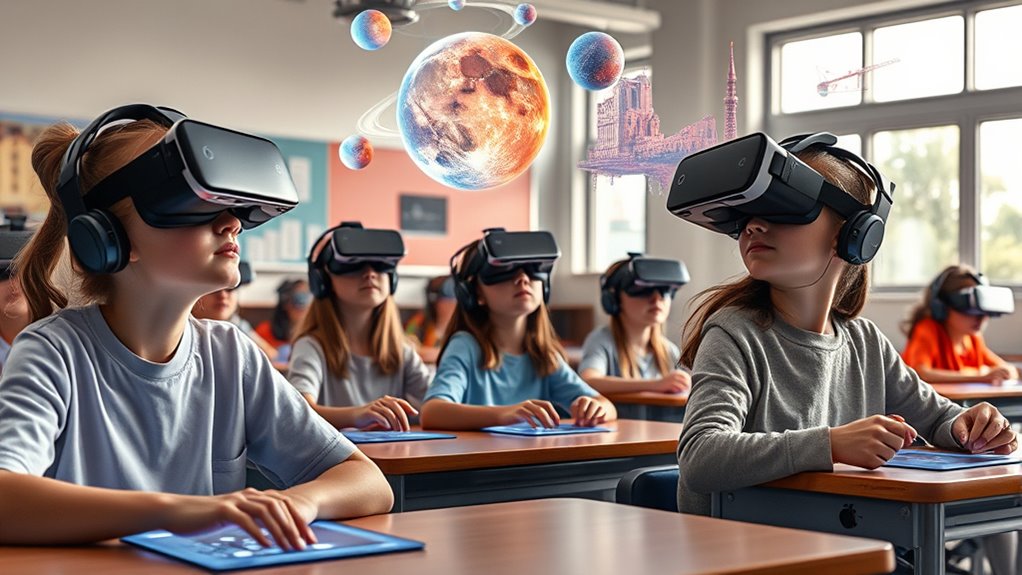

Immersive learning with VR and AR is revolutionizing classrooms by creating engaging, realistic experiences that boost understanding and retention. You can explore ancient civilizations, galaxies, or conduct virtual experiments, making lessons more dynamic and accessible. These technologies eliminate physical barriers and let you revisit scenes as needed, making learning personalized and memorable. As these tools evolve, they promise even more sophisticated ways to explore and understand the world around you—if you’re curious, keep exploring further.
Key Takeaways
- VR and AR create engaging, immersive environments that transform traditional classroom experiences into dynamic, memorable learning adventures.
- They enable virtual field trips and simulations, making complex concepts easier to understand and explore.
- Immersive technologies promote active participation, critical thinking, and hands-on learning in a safe, controlled setting.
- As technology advances, classrooms will become more realistic and sensory-rich, enhancing student engagement and retention.
- The integration of VR and AR is revolutionizing education, opening new possibilities for personalized and accessible learning worldwide.
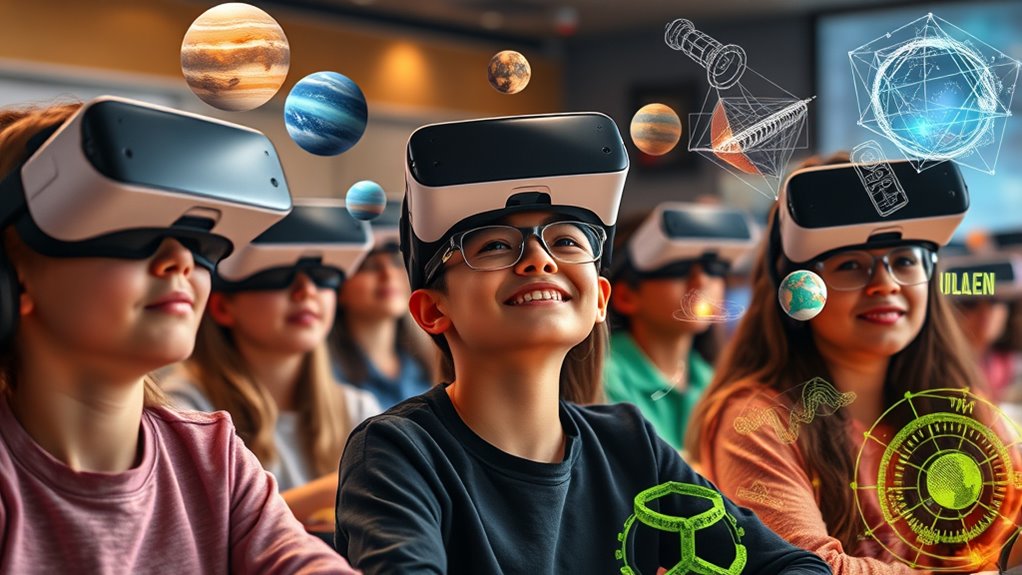
Have you ever imagined learning experiences that fully transport you into a different world? With virtual reality (VR) and augmented reality (AR), that’s now possible. These technologies create immersive environments that make education more engaging and impactful. Instead of reading about ancient civilizations or distant planets from a textbook, you can explore them firsthand through virtual field trips. Imagine walking through the streets of ancient Rome, standing atop the Great Wall of China, or floating in space—without leaving your classroom. These virtual excursions offer a level of interaction and realism that traditional lessons can’t match, making history and science come alive in ways that captivate your attention.
Virtual field trips are a game-changer because they eliminate many logistical challenges associated with physical trips. No need to worry about transportation, time constraints, or safety concerns. With just a headset or even a smartphone, you can access a vast array of destinations across the globe or even in outer space. These experiences deepen understanding by providing visual and sensory details that textbooks often lack, helping you grasp complex concepts more intuitively. Plus, virtual field trips can be tailored to suit different learning styles, allowing you to explore topics at your own pace, revisit scenes as needed, and engage with the environment interactively.
Interactive simulations take this immersive learning a step further. Instead of passively observing, you actively participate in simulations that mimic real-world scenarios. For example, in a virtual lab, you might mix chemicals, conduct experiments, or troubleshoot engineering problems. These hands-on experiences are invaluable because they promote critical thinking and problem-solving skills. When you’re immersed in a simulation, mistakes become part of the learning process, and you gain confidence in your abilities without the fear of real-world consequences. Teachers can customize these simulations to target specific skills or concepts, making lessons more personalized and effective.
Both virtual field trips and interactive simulations leverage the power of VR and AR to transform traditional education. They make learning more dynamic, memorable, and accessible. You’re no longer confined to the physical limits of your classroom or the boundaries of a textbook. Instead, you step into a digital universe that complements and enhances your education. As these technologies continue to evolve, they’ll offer even richer, more realistic experiences, opening new avenues for discovery and understanding. With VR and AR, the future of classrooms is exciting, engaging, and infinitely more immersive. Incorporating realistic visuals and sensory details can further enhance engagement and learning retention.
Top picks for "immersive learn future"
Open Amazon search results for this keyword.
As an affiliate, we earn on qualifying purchases.
Frequently Asked Questions
How Cost-Effective ARe VR and AR Solutions for Schools?
VR and AR solutions can be cost-effective for schools, especially when considering long-term benefits like enhanced engagement and improved learning outcomes. While initial investments may strain budgets, these technologies often integrate well with existing systems, reducing additional costs. Careful planning helps manage budget constraints, making the technology more accessible and sustainable. Over time, the educational gains can outweigh the upfront expenses, making VR and AR a worthwhile investment for innovative classrooms.
What Are the Potential Health Impacts of Prolonged Vr/Ar Use?
Prolonged VR and AR use can cause visual fatigue in up to 70% of users, making your eyes tire quickly. You might also experience motion sickness, with symptoms like dizziness or nausea, especially after extended sessions. These health impacts highlight the importance of taking regular breaks and limiting screen time. Staying mindful of these risks helps guarantee that immersive learning remains safe and beneficial for your well-being.
How Do VR and AR Impact Student Social Interactions?
You might find that VR and AR enhance your social interactions through virtual collaboration, allowing you to work seamlessly with classmates regardless of location. These technologies foster emotional engagement by creating immersive experiences that make communication more personal and dynamic. However, they can also limit face-to-face interactions, so it’s essential to balance virtual socialization with real-world connections to develop well-rounded social skills.
What Training Do Teachers Need to Effectively Use VR and AR?
Your teacher tech skills must be as sharp as a samurai sword to master VR and AR effectively. You need training in immersive pedagogy to design engaging, meaningful experiences. Focus on understanding hardware, software, and safety protocols to foster student confidence. Attending workshops, online courses, and peer collaboration will boost your proficiency, ensuring you harness VR and AR’s full potential for transformative learning.
Are There Any Accessibility Concerns With Immersive Learning Technologies?
You should be aware that immersive learning technologies can raise accessibility concerns, especially regarding the digital divide and physical accessibility. Not all students have reliable internet or devices, which can limit participation. Additionally, students with physical disabilities might face challenges using VR and AR equipment. To guarantee inclusivity, you need to take into account these barriers and explore solutions like adaptive hardware or offline alternatives, so every student benefits equally.
Conclusion
You might be surprised to learn that over 70% of students using VR and AR report increased engagement and understanding. As immersive technology continues to evolve, it’s clear these tools will transform classrooms, making learning more interactive and fun. Embracing VR and AR today paves the way for a future where education feels more like an adventure. So, why not get ready to experience the classroom of tomorrow? The future’s just a headset away!