

The mind-body debate questions whether consciousness and mental experiences come solely from physical brain processes or if they have a non-physical, separate existence. Neuroscience explores how neural networks create awareness, supporting physicalist ideas, while philosophy examines whether consciousness is a fundamental part of reality or an emergent property. Your curiosity about this complex issue can reveal how science and philosophy intersect on understanding what it means to be conscious. Keep exploring to uncover more insights.
Key Takeaways
- The debate contrasts dualism, viewing mind and body as separate, with physicalism, which sees mental states as brain-based processes.
- Neuroscience explores how neural complexity may give rise to consciousness, supporting the emergent property perspective.
- Philosophical discussions question whether consciousness is a fundamental aspect of the universe or an emergent phenomenon.
- The subjective experience (“what it feels like”) challenges purely physical explanations of consciousness.
- Understanding the mind-body relationship influences views on mental health, free will, and concepts like the soul or afterlife.
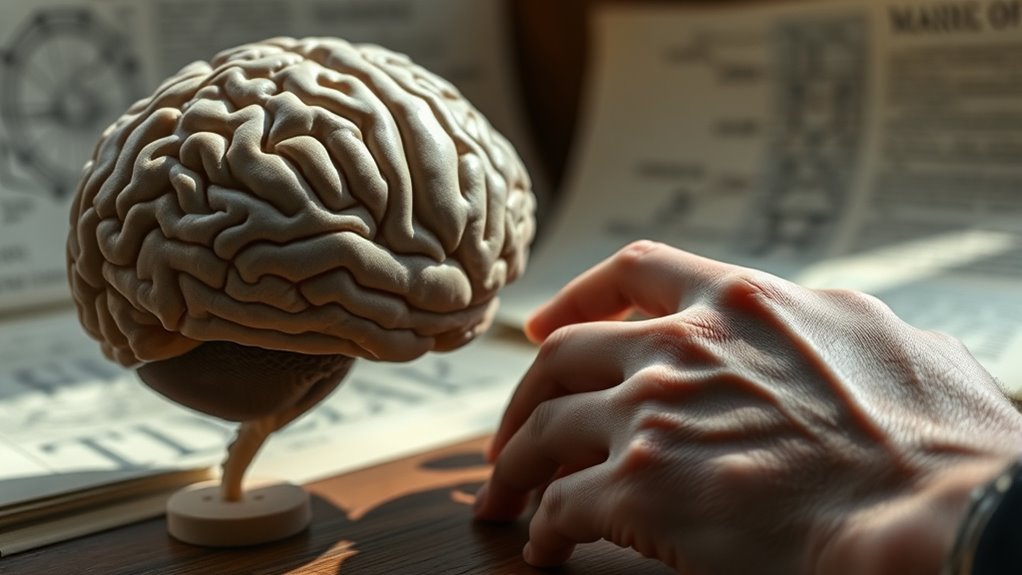
The mind-body debate has long centered on whether our mental experiences are separate from, or fundamentally connected to, our physical existence. At the heart of this discussion lies the concept of consciousness emergence—how subjective awareness arises from the brain’s physical processes. Some argue that consciousness is an emergent property, meaning it arises when neural networks reach a certain level of complexity, tying mental phenomena directly to physical activity. Others believe that consciousness cannot be fully explained by physical mechanisms alone, suggesting it exists as a non-physical entity. This divergence reflects the classic debate between dualism and physicalism. Dualism posits that mind and body are distinct substances; your thoughts and feelings aren’t reducible to brain activity, implying a separate, perhaps non-material, domain of consciousness. Conversely, physicalism claims that everything about the mind can be explained through physical processes in the brain, with no need to invoke non-material substances. This perspective suggests that mental states are simply brain states—patterns of neural activity that give rise to your subjective experiences. Understanding consciousness emergence clarifies why this debate persists. If consciousness truly emerges from neural complexity, then advances in neuroscience could eventually map and explain every aspect of your mental life. You might imagine that as your brain develops or changes, your conscious experience shifts accordingly, reinforcing the physicalist view. However, the subjective nature of experience—the “what it feels like” to be you—continues to challenge purely physical explanations. This is where dualism gains ground, proposing that consciousness has an independent reality that can’t be fully reduced to brain activity. Philosophers and scientists debate whether consciousness is a fundamental aspect of the universe, like space and time, or a byproduct of neural functions. Moreover, ongoing research in AI security demonstrates how complex systems can exhibit emergent properties that challenge traditional boundaries of understanding. Your understanding of this debate influences how you see yourself and your relationship to your body. If you lean toward physicalism, you might view mental states as functions of your brain’s hardware, making mental health and cognition a matter of biological processes. If you support dualism, you could see your mind as something that persists beyond physical changes, which influences ideas about the soul, free will, or afterlife. Ultimately, the question of consciousness emergence and whether dualism or physicalism offers a more accurate picture remains open. It’s an ongoing exploration that shapes not just philosophy, but neuroscience and your understanding of what it means to be conscious.

Healing the Traumatized Self: Consciousness, Neuroscience, Treatment (Norton Series on Interpersonal Neurobiology)
As an affiliate, we earn on qualifying purchases.
As an affiliate, we earn on qualifying purchases.
Frequently Asked Questions
How Do Different Cultures Interpret the Mind-Body Relationship?
You’ll find that cultural perspectives greatly shape how different societies interpret the mind-body relationship. Some cultures, guided by spiritual beliefs, see the mind and body as interconnected and sacred, emphasizing harmony and balance. Others view them as distinct entities, with the mind linked to spiritual or divine domains. These interpretations influence practices like meditation, healing, and rituals, reflecting each culture’s unique understanding of how the mind and body relate.
What Are the Practical Implications of Mind-Body Theories in Medicine?
Imagine a patient holding both a meditation stone and a stethoscope; it’s a reminder that mind-body dualism influences medicine today. You see, recognizing the mind’s role in physical health leads to holistic medicine approaches, emphasizing mental well-being alongside physical treatment. This integration improves outcomes, reduces stress, and fosters patient-centered care. Embracing these theories helps practitioners treat the whole person, not just isolated symptoms, enhancing overall health and healing.
Can Artificial Intelligence Develop a Conscious Mind?
AI can’t develop true machine consciousness yet, as current technology lacks the complexity and subjective experience necessary. While AI may simulate behaviors associated with consciousness, it doesn’t possess genuine awareness. This raises important AI ethics questions about how we treat such systems. If machine consciousness becomes possible, you’ll need to take into account ethical implications, ensuring responsible development and avoiding potential harm caused by creating entities with some form of awareness.
How Does Quantum Physics Influence the Philosophy of Mind?
Did you know that about 60% of scientists believe quantum physics influences consciousness? Quantum consciousness suggests that our mind’s workings might involve quantum processes, especially entanglement theories, which propose particles remain interconnected regardless of distance. This idea challenges traditional views by implying that consciousness could be rooted in quantum phenomena, opening new philosophical debates about free will, perception, and the nature of reality itself.
What Are the Ethical Considerations in Consciousness Research?
You need to prioritize informed consent and privacy concerns in consciousness research. Guarantee participants fully understand the study’s purpose and potential risks, respecting their autonomy. Protect their personal data and confidentiality to prevent misuse. Consider the ethical implications of manipulating consciousness, and avoid harm or exploitation. Upholding these standards fosters trust, maintains integrity, and aligns with moral responsibilities toward participants and society.

Philosophy of Mind
As an affiliate, we earn on qualifying purchases.
As an affiliate, we earn on qualifying purchases.
Conclusion
You might imagine your mind as a bustling city and your body as its streets. Just like traffic flows between them, neuroscience and philosophy reveal how they’re interconnected, shaping your experience. Recent studies show brain activity mirrors conscious thoughts, like a mirror reflecting a face. This ongoing debate is like steering a maze—sometimes clear, sometimes complex—but understanding their dance helps you see how you’re truly alive, aware, and whole.

Philosophy of Mind: A Beginner's Guide to the Great Debates over Consciousness, Free Will, and the Relationship Between Mind and Body, Including the … (Beginner's Guide to Philosophical Movements)
As an affiliate, we earn on qualifying purchases.
As an affiliate, we earn on qualifying purchases.

Conscious: A Brief Guide to the Fundamental Mystery of the Mind
As an affiliate, we earn on qualifying purchases.
As an affiliate, we earn on qualifying purchases.