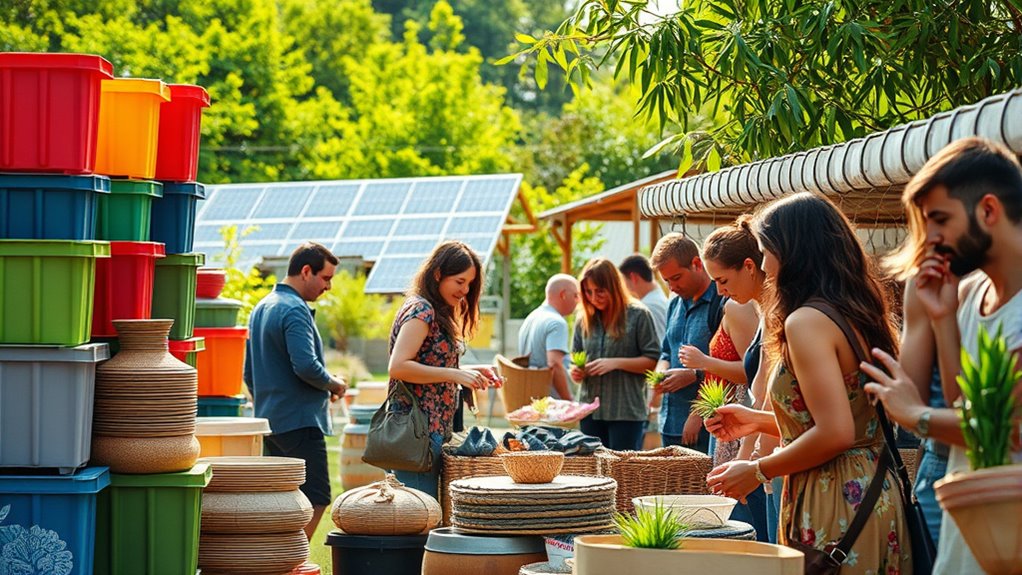

A circular economy redefines how you produce and consume by emphasizing reuse, repair, and recycling instead of the traditional linear model of waste. It encourages designing products with their entire lifecycle in mind, reducing waste and raw material demand. This approach benefits both the environment and economy by conserving resources and cutting down emissions. If you want to explore how this sustainable shift can reshape industries and everyday life, there’s plenty more to discover.
Key Takeaways
- The circular economy promotes resource reuse, repair, and recycling, shifting from a linear “produce-use-discard” model.
- It emphasizes sustainable product design with lifecycle considerations, modularity, and eco-friendly materials.
- Resource management strategies focus on regeneration, efficient use, and supporting remanufacturing and recycling techniques.
- Benefits include reduced environmental impact, conservation of resources, and strengthened local economies through shorter supply chains.
- Practical models prioritize resource optimization and innovative product development to transform traditional consumption patterns.
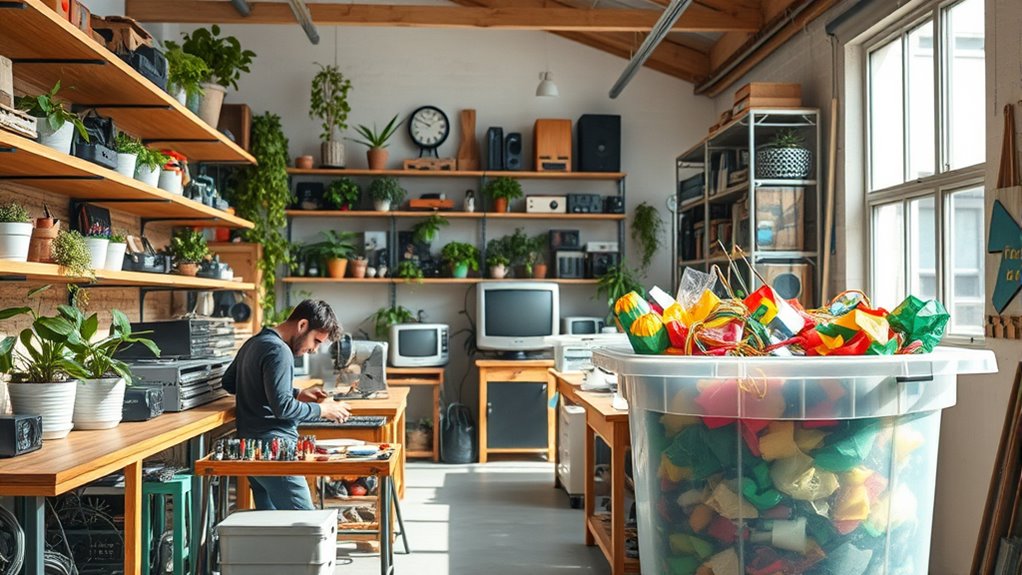
Have you ever wondered how we can reduce waste and make better use of resources? The answer lies in embracing the principles of a circular economy, which aims to redefine how we produce and consume. Instead of following a linear model—where products are made, used, and then discarded—a circular economy promotes a continuous loop of reuse, repair, and recycling. This shift isn’t just about waste management; it’s about fundamentally changing our approach to resource management to create a more sustainable future. One of the core strategies in this model is sustainable design. When you focus on designing products with their entire lifecycle in mind, you ensure they can be easily disassembled, repaired, or repurposed at the end of their use. This approach minimizes waste and reduces the demand for raw materials, which are often finite and environmentally damaging to extract. Sustainable design encourages innovation by prompting manufacturers to think creatively about how products are built—using eco-friendly materials, modular components, and designs that facilitate reuse. It’s about creating goods that serve multiple functions over time, rather than becoming obsolete or disposable.
Additionally, implementing effective Gold IRA fees management can serve as a model for optimizing resource allocation and reducing unnecessary costs in sustainable practices. Resource management plays a critical role in this process, too. Instead of extracting resources and discarding them after a single use, a circular economy emphasizes efficient use and regeneration. You’re encouraged to view resources as valuable assets that can be continuously cycled back into the system. This means improving recycling techniques, developing new materials that are easier to break down, and establishing systems that support the refurbishment and remanufacturing of products. When resource management is optimized, it reduces the environmental footprint and conserves natural ecosystems, which are often harmed by conventional production methods. This approach also promotes local sourcing and shorter supply chains, decreasing transportation emissions and supporting regional economies.

Masirs Reusable Grocery Bag (10-PACK | COLORS) – Reusable Ripstop Bags – Large, Strong Eco Friendly Bags – Foldable Shopping Bag – For Kitchen, Grocery & More – Packable Shopping Bag
REUSABLE: Reduce the usage of wasteful disposable bags and take along this reusable Shopping Bag on all your…
As an affiliate, we earn on qualifying purchases.
As an affiliate, we earn on qualifying purchases.
Frequently Asked Questions
How Does the Circular Economy Impact Global Supply Chains?
The circular economy boosts your global supply chains by enhancing resilience and resource efficiency. It encourages you to reuse, recycle, and repurpose materials, reducing dependency on raw resources and vulnerable suppliers. This approach minimizes disruptions, saves costs, and promotes sustainability. You’ll find that with a circular model, your supply chain becomes more adaptable, less wasteful, and better prepared for future challenges, ultimately strengthening your competitive edge in the global market.
What Are the Main Challenges in Transitioning to a Circular Economy?
Imagine the world’s resources slipping through your fingers like grains of sand. Moving to a circular economy faces major hurdles, such as resource scarcity and technological barriers. You must overcome these challenges to create sustainable systems. It’s a complex journey, requiring innovation, investment, and mindset shifts. But if you stay committed, you can help turn these obstacles into opportunities for a resilient, regenerative future that benefits everyone.
How Can Small Businesses Adopt Circular Economy Principles Effectively?
You can adopt circular economy principles by focusing on local sourcing and increasing product longevity. Start by sourcing materials locally to reduce waste and support your community. Design products that last longer, encouraging repairs and upgrades instead of replacements. Educate your team about sustainability practices, and communicate these efforts to customers. Small changes like these help you reduce environmental impact and align your business with circular economy goals effectively.
What Role Do Government Policies Play in Promoting Circular Economy Practices?
Government policies set the stage for circular economy success; without them, progress stalls. They play a vital role by providing regulatory incentives that encourage sustainable practices and establishing policy frameworks that guide businesses toward resource efficiency. You benefit from clear standards and support systems, making it easier to innovate and adopt circular models. In this way, policies create a balanced environment where sustainable growth becomes not just possible, but inevitable.
How Does Consumer Behavior Influence the Success of Circular Economy Initiatives?
Your consumer motivation and recycling habits directly impact the success of circular economy initiatives. When you’re motivated to reduce waste and actively recycle, you help close the loop on resource use. Your choices encourage businesses to adopt sustainable practices and develop products designed for reuse and recycling. By staying informed and making eco-friendly decisions, you enhance the effectiveness of circular economy efforts, driving positive change for the environment and society.

DIY Modular Furniture: Space-Saving Solutions for Small Homes
As an affiliate, we earn on qualifying purchases.
As an affiliate, we earn on qualifying purchases.
Conclusion
Embracing the circular economy is like planting seeds in a forest that never ends—you nurture growth, refuse waste, and watch resources flourish anew. You become part of a cycle where nothing truly disappears, only transforms. By shifting your mindset, you’re weaving a tapestry of sustainability, turning yesterday’s leftovers into tomorrow’s treasures. Together, you can create a world where production and consumption dance in harmony, ensuring the earth’s symphony plays on for generations to come.

EPICA Countertop Compost Bin Kitchen | 1.3 Gallon | Odorless Composting Bin with Carbon Filters | Indoor Compost Bin with Lid | Stainless Steel Kitchen Composter for Food Scraps & Waste Recycling
FEATURED IN BON APPETIT & FORBES: Recognized by renowned magazines, EPICA’s compost bin is a perfectly sized marvel…
As an affiliate, we earn on qualifying purchases.
As an affiliate, we earn on qualifying purchases.

B08F7Z6DMV
As an affiliate, we earn on qualifying purchases.
As an affiliate, we earn on qualifying purchases.