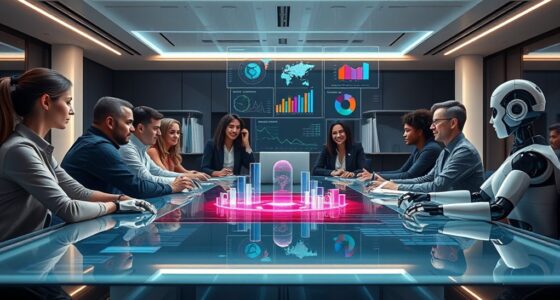
AI is reshaping your everyday expertise by offering personalized support and instant insights that help you make smarter decisions quickly. It shifts reliance from traditional knowledge to intelligent tools, requiring you to adapt your skills and develop critical thinking to interpret AI suggestions effectively. As AI personalizes learning and automates tasks, your ability to stay updated and understand its strengths and limits becomes more essential. Keep exploring, and you’ll discover how to harness AI to enhance your skills further.
Key Takeaways
- AI personalizes learning and skill development, enabling tailored and real-time knowledge acquisition.
- Reliance shifts from traditional experts to AI tools for instant insights and decision-making.
- Critical thinking and interpretation of AI outputs become essential skills for effective collaboration.
- Continuous learning about AI capabilities enhances understanding and smarter use of technology.
- AI transforms expertise by augmenting human judgment and promoting adaptability across everyday tasks.
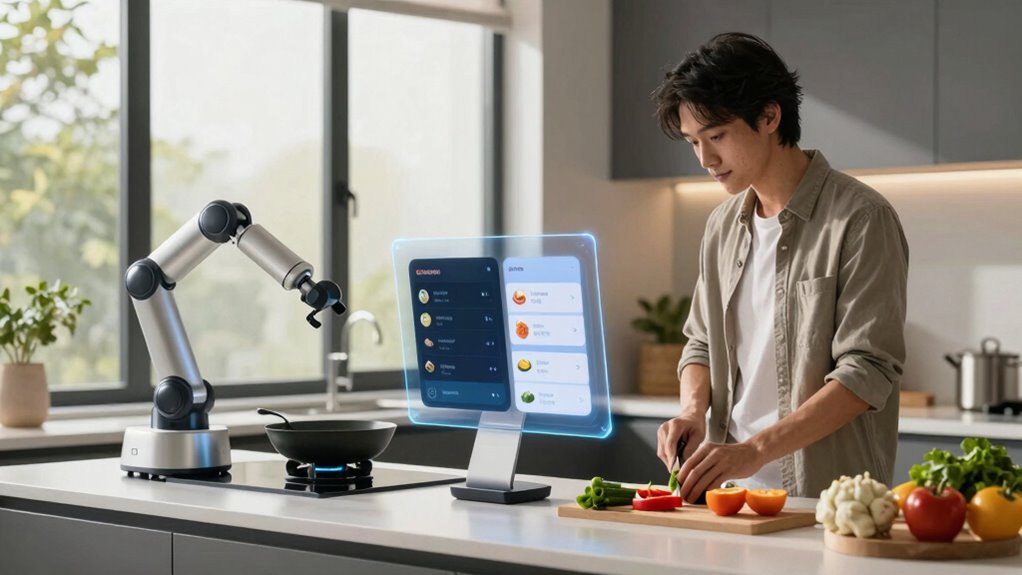
Artificial intelligence is increasingly woven into your daily routines, transforming how you access and rely on expertise. From personalized recommendations to real-time problem solving, AI integration is reshaping the way you navigate various tasks. Instead of solely depending on traditional knowledge or human experts, you now have intelligent tools that offer instant insights, guiding your decisions with accuracy and speed. This shift means you can accomplish more in less time, but it also demands that you adapt your skills to work alongside these advanced technologies. Skill adaptation becomes essential as you learn to interpret AI outputs, question its suggestions, and combine machine insights with your own judgment.
Adapting skills to interpret and question AI insights is key to working effectively alongside intelligent tools.
As AI becomes more integrated into your everyday life, your ability to adapt your skills will determine how effectively you leverage these tools. For example, in professional settings, you might need to develop new competencies for managing AI-driven data analysis or automation processes. These skills aren’t just technical; they include critical thinking to assess AI recommendations and emotional intelligence to handle situations where human touch remains irreplaceable. By honing these skills, you enhance your capacity to work efficiently with AI, turning it from a mere tool into a partner that amplifies your expertise.
You’ll also find that AI integration influences how you acquire knowledge. Instead of solely relying on textbooks or expert advice, you might turn to AI-powered platforms that personalize learning experiences or provide real-time feedback. This means that skill acquisition becomes more dynamic and tailored to your needs, but it also places the responsibility on you to stay updated with evolving technologies. As AI continues to advance, your ability to adapt your skillset will be crucial for staying relevant in your career and personal pursuits. Additionally, understanding projector technology can help you make smarter decisions when setting up home entertainment systems, ensuring optimal image quality and performance.
Moreover, this ongoing transformation encourages you to develop a mindset of continuous learning. The more you familiarize yourself with AI capabilities, the better you’ll understand its limitations and strengths. This understanding helps you make smarter decisions and use AI tools more effectively. Ultimately, the integration of AI into everyday expertise isn’t just about replacing human effort but about enhancing your skills and making you more competent in a rapidly changing world. Embracing this change means staying proactive, learning new skills, and being open to how AI can support your growth rather than hinder it.
AI-powered personal learning platforms
As an affiliate, we earn on qualifying purchases.
As an affiliate, we earn on qualifying purchases.
Frequently Asked Questions
How Does AI Personalize Learning and Skill Development for Individuals?
AI personalizes learning and skill development by providing tailored feedback based on your progress and needs. It uses adaptive learning algorithms to adjust the difficulty and content, ensuring you stay engaged and challenged without feeling overwhelmed. This customization helps you focus on areas that need improvement, making your learning experience more efficient and effective. With AI, your education becomes more responsive, guiding you toward mastery at your own pace.
Can AI Replace Human Intuition in Everyday Decision-Making?
AI can’t fully replace human intuition in decision-making because of AI biases that can skew results, and because decision transparency remains limited. While AI provides valuable data and insights, your intuition considers emotional nuances and context that algorithms often overlook. Trusting your instincts alongside AI’s recommendations helps balance objectivity with empathy, leading to more well-rounded decisions that machines alone can’t achieve.
What Ethical Concerns Arise From Ai’s Role in Skill Assessment?
You should consider that AI’s role in skill assessment raises ethical concerns like bias issues and privacy concerns. Bias issues can lead to unfair evaluations, harming deserving individuals, while privacy concerns involve how personal data is collected, stored, and used. You need to guarantee transparency and fairness in AI systems, advocating for strict data protection measures to prevent misuse and uphold ethical standards in skill assessment processes.
How Accessible Is AI Technology for Different Socioeconomic Groups?
AI technology is like a bridge that can connect or divide communities. Socioeconomic barriers and the digital divide make it difficult for some groups to access AI tools. You might find that wealthier areas have better internet and devices, while others struggle with basic connectivity. This gap means AI’s benefits aren’t evenly distributed, risking increased inequality. To guarantee fairness, efforts must focus on making AI accessible to everyone, regardless of economic status.
What Are the Limitations of AI in Replicating Expert Judgment?
AI struggles to fully replicate expert judgment because it relies heavily on data quality and bias mitigation. If the data contains biases or gaps, AI may produce skewed or inaccurate results. You might find AI useful for support, but it can’t replace nuanced human insight, especially in complex decision-making. Limitations include difficulty understanding context, emotions, and ethical considerations that experts naturally navigate.
As an affiliate, we earn on qualifying purchases.
Conclusion
Just as Icarus reached toward the sun, you now harness AI’s power to elevate your skills and knowledge. This technology isn’t just changing how you learn—it’s transforming what you can achieve. Like Da Vinci’s brush or Newton’s apple, AI becomes a tool that expands your horizons, making expertise more accessible and personal. Embrace this new dawn, where human ingenuity and artificial intelligence dance together, shaping a future where your potential knows no bounds.
critical thinking training courses
As an affiliate, we earn on qualifying purchases.
As an affiliate, we earn on qualifying purchases.
As an affiliate, we earn on qualifying purchases.