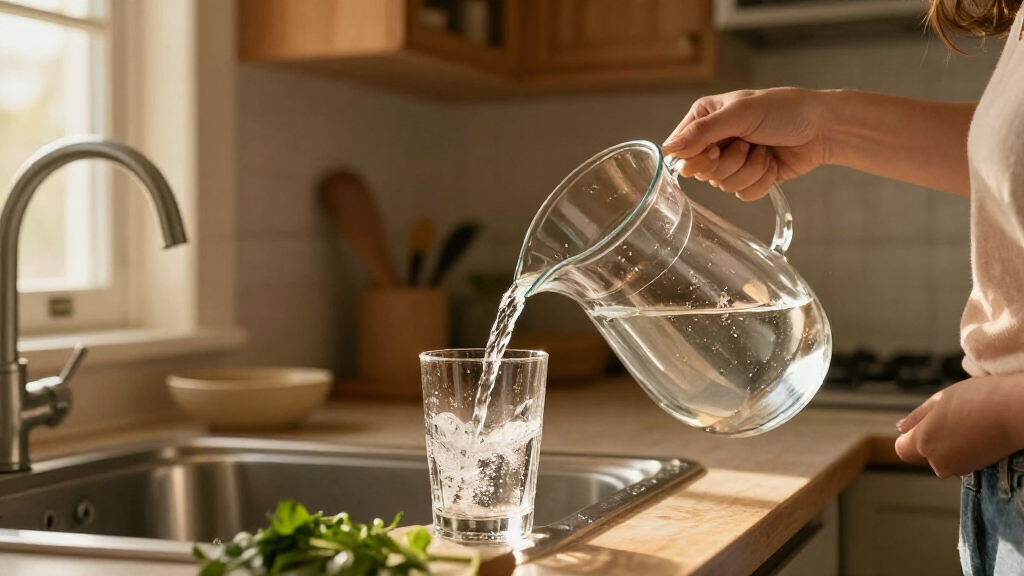
For most households seeking water filter pitchers for clean drinking water, the Brita Large 10-Cup Elite is my best overall pick for its practical capacity and a filter designed to reduce more contaminants than a basic pitcher filter. The Clearly Filtered 10-Cup Pitcher stands out for buyers who prioritize broader contaminant reduction, while the Brita UltraMax 27-Cup Dispenser suits families who want more filtered water ready at once. The main tradeoffs are filtration scope, refill frequency, refrigerator space, and the ongoing work of replacing filters. No single pitcher is right for every water supply, so check what your local water report says before choosing a filter. Read on for the full breakdown and help matching a pitcher to your household.

Get health and wellness essentials delivered free with Prime
- Fast, free delivery on millions of items
- Prime Video, Amazon Music and more included
- Member-only deals all year
Key Takeaways
- Brita Large 10-Cup Elite leads this comparison as a balanced everyday choice: it pairs family-friendly capacity with a more advanced filter than the standard-filter Brita pitchers.
- Clearly Filtered is the standout for shoppers prioritizing broader contaminant reduction, but its specialized approach may be more than someone seeking basic taste improvement needs.
- Brita UltraMax 27-Cup and Waterdrop WFD-40L 35-Cup trade countertop and refrigerator space for fewer refills, making dispenser size a real household-fit decision.
- ZeroWater and Culligan ZeroWater pitchers include a TDS meter, which can show changes in total dissolved solids but cannot identify every contaminant or certify water as safe.
- Compact, low-cost, and glass options serve different priorities: Brita Metro and Space Saver fit tighter spaces, Amazon Basics supports a simpler budget-minded setup, and Waterdrop‘s glass pitcher favors material preference over maximum capacity.
| Brita Large 10-Cup Elite Water Filter Pitcher with 1 Filter, White |  | Best Overall | Capacity: 10 cups | Filter: Brita Elite, activated carbon | Filter life: 120 gallons or about 6 months | VIEW LATEST PRICE | See Our Full Breakdown |
| PUR 7-Cup Water Filter Pitcher with Filter, White |  | Best for Easy-Care Compact Use | Capacity: 7 cups | Included filter: Genuine PUR 2-in-1 activated carbon filter | Filter life: Up to 40 gallons or 2 months | VIEW LATEST PRICE | See Our Full Breakdown |
| Brita UltraMax 27-Cup Water Filter Dispenser with Brita Plus Filter | 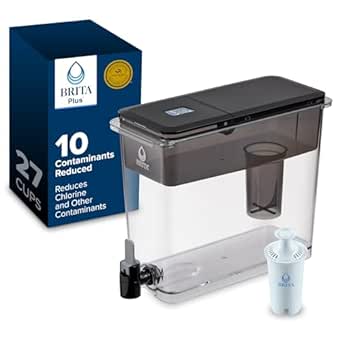 | Best for High-Volume Households | Capacity: 27 cups | Filter: Brita Plus | Filter life: 40 gallons or about 2 months | VIEW LATEST PRICE | See Our Full Breakdown |
| Brita Space Saver 6-Cup Water Filter Pitcher |  | Best for Tight Refrigerator Spaces | Capacity: 6 cups | Purification method: Activated carbon and ion exchange | Reduces: Chlorine taste and odor, copper, mercury, and cadmium | VIEW LATEST PRICE | See Our Full Breakdown |
| Philips Electric Water Filter Pitcher and Dispenser, ADD5902 |  | Best for Fast, Button-Free Dispensing | Model: ADD5902 | Capacity: 12 cups | Purification method: Carbon block, 0.5 µm pore size | VIEW LATEST PRICE | See Our Full Breakdown |
| ZeroWater 10-Cup Ready-Pour Water Filter Pitcher with TDS Meter |  | Best for Monitoring Dissolved Solids | Capacity: 10 cups | Filtration stages: 5 | Purification method: Ion exchange | VIEW LATEST PRICE | See Our Full Breakdown |
| Clearly Filtered 10-Cup Water Filter Pitcher |  | Best for Broad Contaminant Coverage | Capacity: 80 fl oz (10 cups / approximately 2.4 L) | Filter life: Up to 100 gallons; approximately 4 months | Filtration method: Affinity Filtration | VIEW LATEST PRICE | See Our Full Breakdown |
| Brita 10-Cup Water Filter Pitcher with 1 Filter, Bright White |  | Best for Straightforward Everyday Use | Capacity: 10 cups | Included filter: 1 | Purification method: Granular activated carbon | VIEW LATEST PRICE | See Our Full Breakdown |
| Waterdrop PT-05B-L 7-Cup Water Filter Pitcher, Blue | 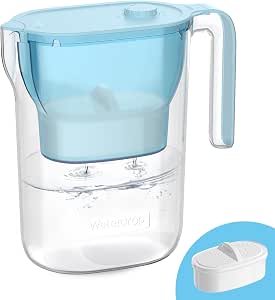 | Best Compact Pick | Capacity: 7 cups | Filtration: Activated carbon fiber | Filter life: Up to 3 months or 200 gallons, depending on water conditions and usage | VIEW LATEST PRICE | See Our Full Breakdown |
| Culligan ZeroWater 10-Cup Water Filter Pitcher with TDS Meter, Aqua |  | Best for PFAS and Lead Monitoring | Capacity: 80 fluid ounces (10 cups) | Filtration: 5-stage; activated carbon and ion exchange | Certified contaminant reduction: Total PFAS, lead, chlorine, mercury, and other contaminants | VIEW LATEST PRICE | See Our Full Breakdown |
| Waterdrop WFD-40L Water Filter Dispenser, 35-Cup Capacity, Black |  | Best for High-Capacity Fridge Storage | Capacity: 35 cups total; 19 cups in the dispenser body | Dimensions: 14.4 x 5.5 x 10.2 inches | Filtration method: Activated carbon fiber | VIEW LATEST PRICE | See Our Full Breakdown |
| Brita Metro 6-Cup Water Filter Pitcher with SmartLight Indicator, Fiery Red | 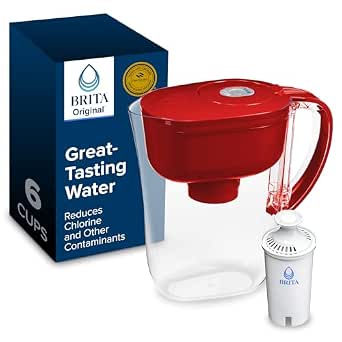 | Best for Mini-Fridges and Solo Drinkers | Capacity: 6 cups | Dimensions: 10.12 x 10.04 x 4.82 inches | Material: BPA-free plastic | VIEW LATEST PRICE | See Our Full Breakdown |
| Brita UltraMax 27-Cup Water Dispenser with Standard Filter, Black |  | Best for Shared Households | Capacity: 27 cups | Dimensions: 18 x 5.67 x 10.47 inches | Material: BPA-free plastic | VIEW LATEST PRICE | See Our Full Breakdown |
| Amazon Basics 10-Cup Water Filter Pitcher, Compatible with Brita Filters |  | Best for Broad Contaminant Coverage in a Compact Pitcher | Capacity: 10 cups | Dimensions: 9.84 x 5.7 x 10 inches | Weight: 2.0 pounds | VIEW LATEST PRICE | See Our Full Breakdown |
| Waterdrop PT-72W 7-Cup Glass Water Filter Pitcher, White |  | Best Glass Pitcher for Listed Contaminant Reduction | Capacity: 7 cups | Dimensions: 8.1 x 5.9 x 8.5 inches | Material: Glass body with plastic inner liner | VIEW LATEST PRICE | See Our Full Breakdown |
| water filter pitchers for clean drinking water | Capacity | Dimensions | Filter life | Material |
|---|---|---|---|---|
| Brita Large 10-Cup Elite Water | 10 cups | 10.94 × 5.59 × 10.47 inches | 120 gallons or about 6 months | BPA-free plastic |
| PUR 7-Cup Water Filter Pitcher | 7 cups | 9.6 × 9.6 × 10.1 inches | Up to 40 gallons or 2 months | Plastic |
| Brita UltraMax 27-Cup Water Fi | 27 cups | 11.18 × 14.57 × 5.63 inches | 40 gallons or about 2 months | BPA-free plastic |
| Brita Space Saver 6-Cup Water | 6 cups | 9.88 × 4.75 × 10.13 inches | 40 gallons or about 2 months | BPA-free plastic |
| Philips Electric Water Filter | 12 cups | 9.17 × 5.98 × 10.35 inches | Description: 3 months or 60 gallons; product details also list 6 months | — |
| ZeroWater 10-Cup Ready-Pour Wa | 10 cups | 11.63 x 5.93 x 11 in | — | BPA-free plastic |
| Clearly Filtered 10-Cup Water | 80 fl oz (10 cups / approximately 2.4 L) | 10.87 x 5.25 x 11.4 in | Up to 100 gallons; approximately 4 months | Medical-grade Tritan; BPA- and BPS-free |
| Brita 10-Cup Water Filter Pitc | 10 cups | — | — | — |
| Waterdrop PT-05B-L 7-Cup Water | 7 cups | — | Up to 3 months or 200 gallons, depending on water conditions and usage | BPA-free, lead-free plastic |
| Culligan ZeroWater 10-Cup Wate | 80 fluid ounces (10 cups) | 9.5 x 5 x 10.5 inches | — | — |
| Waterdrop WFD-40L Water Filter | 35 cups total; 19 cups in the dispenser body | 14.4 x 5.5 x 10.2 inches | Up to 200 gallons or two months | — |
| Brita Metro 6-Cup Water Filter | 6 cups | 10.12 x 10.04 x 4.82 inches | Up to 40 gallons or about two months | BPA-free plastic |
| Brita UltraMax 27-Cup Water Di | 27 cups | 18 x 5.67 x 10.47 inches | — | BPA-free plastic |
| Amazon Basics 10-Cup Water Fil | 10 cups | 9.84 x 5.7 x 10 inches | — | — |
| Waterdrop PT-72W 7-Cup Glass W | 7 cups | 8.1 x 5.9 x 8.5 inches | Up to 100 gallons or two months | Glass body with plastic inner liner |
More Details on Our Top Picks
Brita Large 10-Cup Elite Water Filter Pitcher with 1 Filter, White
I’d choose this as the strongest all-around pitcher for buyers who want a useful household capacity without giving up refrigerator fit. Its 10-cup size is more practical for everyday sharing than the 6-cup Brita Space Saver, while the included Elite filter is specified to reduce 99% of lead and cut chlorine taste and odor. An electronic SmartLight indicator gives a replacement reminder, and the stated filter life of up to 120 gallons or about six months means fewer changes than the PUR 7-Cup or Brita Space Saver filters, which are rated for about two months. The tradeoff is that this is still a pitcher, not a high-volume dispenser, and its Elite filter is not compatible with Brita Stream models. I’d pick it for a balanced mix of capacity and filter life, not for bulk dispensing.
Pros:- 10-cup capacity offers more servings per refill than the Brita Space Saver or PUR 7-Cup.
- Included Elite filter is specified to reduce 99% of lead and reduce chlorine taste and odor.
- Filter life is rated up to 120 gallons or about six months, longer than several smaller-pitcher options here.
- Electronic SmartLight indicator provides a filter-change reminder.
Cons:- Still requires regular refilling and cannot match the 27-cup Brita UltraMax dispenser for household volume.
- Elite filter is not compatible with Brita Stream pitchers and dispensers.
- Maximum flow rate is listed as 0.05 gpm, so dispensing can take time.
Best for: Households that want a refrigerator-friendly pitcher with room for several servings and a longer stated filter life.
Not ideal for: Brita Stream owners or households that need more water on hand than a 10-cup pitcher can provide.
- Capacity:10 cups
- Filter:Brita Elite, activated carbon
- Filter life:120 gallons or about 6 months
- Indicator:Electronic SmartLight
- Material:BPA-free plastic
- Dimensions:10.94 × 5.59 × 10.47 inches
- Maximum flow rate:0.05 gpm
- Warranty:Limited 1-year warranty
Our verdict“Choose this Brita for a capable everyday pitcher with a long stated filter life, but skip it if you need dispenser-level capacity or Stream compatibility.”
PUR 7-Cup Water Filter Pitcher with Filter, White
The PUR 7-Cup is a sensible fit for buyers who value easy cleanup and a smaller footprint more than long intervals between filter changes. Its dishwasher-safe components set it apart from the Brita Large 10-Cup, while the included Genuine PUR filter uses 2-in-1 activated carbon filtration and is IAPMO certified to reduce chlorine, mercury, and other listed substances. The compact form and easy-fill lid suit routine use in a smaller kitchen or refrigerator. Capacity is the clear compromise: at seven cups, it holds less than the Brita Large and far less than the 27-cup Brita UltraMax dispenser, so a shared household may refill it often. The filter is rated for up to 40 gallons or two months, also a shorter interval than the Brita Large Elite. I’d favor it when simple washing matters more than reducing refill and replacement frequency.
Pros:- IAPMO-certified filter is specified to reduce chlorine, mercury, and other listed substances.
- Dishwasher-safe components make routine cleaning easier.
- Compact 7-cup design is suited to refrigerator storage.
- Easy-fill lid and stay-tight design support everyday handling.
Cons:- Seven-cup capacity may mean frequent refills for families or heavy water drinkers.
- Filter replacement is due after up to 40 gallons or about two months.
- Provides less capacity per fill than the Brita Large 10-Cup and Brita UltraMax dispenser.
Best for: One- or two-person households seeking a compact pitcher with dishwasher-safe components and certified contaminant reduction.
Not ideal for: Larger households that want fewer refills or buyers who prefer the longer stated filter life of the Brita Large Elite.
- Capacity:7 cups
- Included filter:Genuine PUR 2-in-1 activated carbon filter
- Filter life:Up to 40 gallons or 2 months
- Certification:IAPMO certified
- Material:Plastic
- Dimensions:9.6 × 9.6 × 10.1 inches
- Maximum supported TDS:600 ppm
- Power source:Manual
Our verdict“Pick the PUR if easy cleaning and compact storage matter more than capacity or longer filter intervals.”
Brita UltraMax 27-Cup Water Filter Dispenser with Brita Plus Filter
For a household that goes through filtered water quickly, I’d choose the Brita UltraMax over a conventional pitcher. Its 27-cup capacity and spigot let people pour without lifting a full container, a practical difference from the Brita Large 10-Cup and PUR 7-Cup pitchers. The included Brita Plus filter is described as reducing twice as many contaminants as standard Brita filters, including chlorine, mercury, and cadmium, while retaining beneficial minerals. That makes this a capacity-first pick with a more extensive stated reduction profile than the smaller Brita Space Saver. The size is also its main compromise: the wide footprint can crowd a counter or fail to fit in a refrigerator, so buyers should measure their space. Its filter is rated for about two months or 40 gallons, shorter than the Brita Large Elite’s stated life.
Pros:- 27-cup capacity reduces refill frequency compared with standard pitcher formats.
- Spigot makes dispensing easier than lifting and pouring a full pitcher.
- Brita Plus filter is described as reducing twice as many contaminants as standard Brita filters.
- BPA-free plastic construction and WQA NSF/ANSI certification are listed.
Cons:- Large footprint may not suit small refrigerators or crowded countertops.
- Filter life is about 40 gallons or two months, shorter than the Brita Large Elite’s stated interval.
- Specified for potable water sources rather than water requiring treatment as unsafe.
Best for: Families, shared homes, or frequent water drinkers who want a large reservoir and easy spigot dispensing.
Not ideal for: People with limited counter or refrigerator space, or households that want the longer stated filter interval of the Brita Large Elite.
- Capacity:27 cups
- Filter:Brita Plus
- Filter life:40 gallons or about 2 months
- Certification:WQA NSF/ANSI certified
- Material:BPA-free plastic
- Dimensions:11.18 × 14.57 × 5.63 inches
- Maximum supported TDS:1500 ppm
- Dispensing:Spigot
Our verdict“Choose the UltraMax when household capacity and spigot access outweigh its space demands and more frequent filter changes.”
Brita Space Saver 6-Cup Water Filter Pitcher
The Brita Space Saver earns its place by fitting where a larger pitcher may not. Its slim 4.75-inch width and six-cup capacity suit narrow refrigerator shelves and small kitchens; compared with the Brita Large 10-Cup, it gives up volume to occupy less space. The activated carbon and ion-exchange filter is specified to reduce chlorine taste and odor, as well as copper, mercury, and cadmium impurities. A flip-top lid makes filling straightforward, and the electronic indicator tracks filter replacement. The practical downside is the same compact size that makes it easy to store: households will refill it more often, and its filter is rated for only 40 gallons or about two months. Compared with the PUR 7-Cup, it holds less, so I’d reserve this model for genuinely tight storage rather than choosing it as an all-purpose household pitcher.
Pros:- Narrow 4.75-inch width helps it fit tight refrigerator spaces.
- Flip-top lid supports convenient refilling.
- Electronic indicator reminds users when to replace the filter.
- Activated carbon and ion exchange target chlorine taste and odor, copper, mercury, and cadmium.
Cons:- Six-cup capacity is smaller than both the PUR 7-Cup and Brita Large 10-Cup.
- Filter replacement is due every 40 gallons or about two months.
- Not a good fit for households that consume large volumes of filtered water.
Best for: Apartment dwellers and refrigerator users with narrow shelves who want a simple pitcher for one or two people.
Not ideal for: Families or anyone who wants fewer refills, greater capacity, or a longer filter interval.
- Capacity:6 cups
- Purification method:Activated carbon and ion exchange
- Reduces:Chlorine taste and odor, copper, mercury, and cadmium
- Filter life:40 gallons or about 2 months
- Material:BPA-free plastic
- Dimensions:9.88 × 4.75 × 10.13 inches
- Indicator:Electronic filter indicator
- Weight:1.7 pounds
Our verdict“Choose the Space Saver when refrigerator width is the deciding factor, not when capacity or filter life is your priority.”
Philips Electric Water Filter Pitcher and Dispenser, ADD5902
The Philips ADD5902 stands apart from the manual pitchers here by pairing a cordless electric dispenser with a fast stated flow rate of up to one liter per minute. That is a meaningful convenience over pouring from the Brita Large 10-Cup or the PUR 7-Cup, especially for buyers who regularly fill bottles. Its slim 12-cup body is designed for refrigerator-door storage, and the carbon block filter is certified against NSF/ANSI standards 42, 53, and 372; product details claim 99.8% lead reduction and reduction of 46 impurities. This added dispensing hardware brings extra upkeep: the battery lasts up to four weeks per charge, and USB-C charging requires an adapter that is not included. Filter-life information is inconsistent—one description says three months or 60 gallons, while details also list six months—so I’d verify the replacement schedule before buying.
Pros:- Electric dispensing reaches a stated flow rate of up to 1 liter per minute.
- Slim design is made to fit in a refrigerator door.
- Carbon block filter is certified against NSF/ANSI standards 42, 53, and 372.
- Filter reminder and USB-C charging reduce guesswork around operation and power.
Cons:- Battery lasts up to four weeks per charge, adding charging maintenance absent from manual pitchers such as the PUR 7-Cup.
- USB-C power adapter is not included.
- Filter life is presented as both three months or 60 gallons and six months in the product details.
- Designed for cold tap water; hot water may affect filtration and taste.
Best for: Refrigerator users who want faster dispensing for bottles and are comfortable charging an appliance and checking filter-life guidance.
Not ideal for: Buyers seeking a simple manual pitcher, those who do not want charging maintenance, or anyone who needs unambiguous filter replacement intervals.
- Model:ADD5902
- Capacity:12 cups
- Purification method:Carbon block, 0.5 µm pore size
- Filter life:Description: 3 months or 60 gallons; product details also list 6 months
- Maximum flow rate:1 L/min (0.26 GPM)
- Certifications:CSA tested and certified against NSF/ANSI standards 42, 53, and 372
- Battery life:Up to 4 weeks per charge
- Charging:USB-C; adapter not included
- Dimensions:9.17 × 5.98 × 10.35 inches
Our verdict“Choose the Philips for fast, powered dispensing in a refrigerator-friendly format, but only if charging and unclear filter-life guidance are acceptable.”
ZeroWater 10-Cup Ready-Pour Water Filter Pitcher with TDS Meter
For buyers who want to track dissolved solids rather than rely only on taste, this 10-cup ZeroWater pitcher pairs five-stage ion-exchange filtration with an included TDS meter. Its IAPMO-certified reductions include lead, PFOA/PFOS, chromium, and mercury, giving it a different emphasis from the Brita 10-Cup pitcher, which focuses on chlorine taste and odor plus several metals. The meter offers a practical signal for checking water readings and deciding when to replace the filter, but it does not remove the ongoing need to buy compatible replacements. A quick-fill spigot supports pouring without tipping the pitcher, though the 10-cup capacity may mean frequent refills for a larger household. I’d choose this when TDS monitoring matters more than maximizing filter life or keeping maintenance especially simple.
Pros:- Five-stage ion-exchange filtration reduces dissolved solids.
- IAPMO-certified reductions include lead, PFOA/PFOS, chromium, and mercury.
- Included TDS meter lets buyers check water readings.
- Quick-fill spigot and ergonomic handle support easier pouring.
Cons:- Filter replacement is needed when readings indicate a change is due.
- Ten-cup capacity may require frequent refills for larger households.
Best for: Households that want to monitor dissolved-solids readings and prioritize the listed heavy-metal and PFAS reductions.
Not ideal for: Large households that need a high-capacity reservoir, or buyers who want a filter schedule that does not depend on water readings.
- Capacity:10 cups
- Filtration stages:5
- Purification method:Ion exchange
- Certified reductions:Lead, PFOA/PFOS, chromium, and mercury
- TDS meter:Included
- Material:BPA-free plastic
- Dimensions:11.63 x 5.93 x 11 in
- Filter compatibility:ZeroWater and Culligan ZeroWater systems and filters
Our verdict“Choose this ZeroWater when a TDS meter and certified reductions are more useful to you than a longer, simpler filter schedule.”
Clearly Filtered 10-Cup Water Filter Pitcher
The Clearly Filtered pitcher is the broad-coverage choice here: its Affinity Filtration targets a stated 386+ contaminants, including fluoride, lead, PFAS, arsenic, and microplastics, while preserving beneficial minerals. That makes it a better fit for buyers seeking a wide contaminant list than the Brita 10-Cup pitcher, whose listed focus is chlorine taste and odor, copper, mercury, and cadmium. Its 80-fluid-ounce capacity matches the 10-cup ZeroWater, but the Clearly Filtered model has no TDS meter for tracking readings. The BPA- and BPS-free medical-grade Tritan body, hinge-fill lid, and spill-resistant design support everyday refrigerator use. Filter life is listed as up to 100 gallons or about four months, so it still requires scheduled replacement and manual refilling.
Pros:- Targets a broad stated range of contaminants while preserving beneficial minerals.
- BPA- and BPS-free medical-grade Tritan construction.
- Spill-resistant design, ergonomic handle, and hinge-fill lid suit daily use.
- Filter life is listed up to 100 gallons or approximately four months.
Cons:- Filter still needs replacement after its stated capacity or time limit.
- Manual refilling is required.
- Does not include a TDS meter like the ZeroWater and Culligan ZeroWater pitchers.
Best for: Buyers who want a 10-cup refrigerator pitcher targeting a wide range of listed contaminants, including fluoride, arsenic, PFAS, and microplastics.
Not ideal for: Shoppers who want a TDS meter, a very long interval between filter changes, or a pitcher that does not need manual refilling.
- Capacity:80 fl oz (10 cups / approximately 2.4 L)
- Filter life:Up to 100 gallons; approximately 4 months
- Filtration method:Affinity Filtration
- Contaminants targeted:386+
- Material:Medical-grade Tritan; BPA- and BPS-free
- Maximum supported TDS:500 ppm
- Dimensions:10.87 x 5.25 x 11.4 in
- Certifications and testing:NSF/ANSI 42 and 372; product information also lists NSF/ANSI 43, 53, 401, and 473 testing
Our verdict“Pick Clearly Filtered if broad listed contaminant coverage is your priority and you are comfortable refilling and replacing filters on schedule.”
Brita 10-Cup Water Filter Pitcher with 1 Filter, Bright White
This Brita is the lineup’s straightforward choice for improving everyday tap-water taste without adding a TDS meter or a broad, specialized contaminant claim. Its granular activated carbon filter reduces chlorine taste and odor along with copper, mercury, and cadmium; that is a narrower focus than the Clearly Filtered pitcher’s stated coverage of fluoride, PFAS, arsenic, and microplastics. The easy-fill locking lid and refrigerator-friendly shape make routine refills simple, and compatibility with Brita Standard and Longlast filters gives buyers a choice between the listed 40-gallon and 120-gallon filter lives. The included filter is the Standard type, so buyers wanting the longer interval must choose a compatible Longlast replacement. This model makes most sense for familiar, basic filtration needs, not TDS monitoring or extensive contaminant targeting.
Pros:- Reduces chlorine taste and odor, copper, mercury, and cadmium.
- Easy-fill locking lid supports convenient refills.
- Refrigerator-friendly 10-cup design.
- Compatible with Brita Standard and Longlast filters.
Cons:- Included Standard filter is listed for 40 gallons or approximately two months.
- Its stated contaminant focus is narrower than Clearly Filtered’s.
- Pitcher lid and reservoir may vary.
Best for: People who want a familiar 10-cup refrigerator pitcher for chlorine taste and odor reduction, with the option to use two Brita filter types.
Not ideal for: Buyers prioritizing a TDS reading, broad listed contaminant coverage, or the included filter’s longest possible replacement interval.
- Capacity:10 cups
- Included filter:1
- Purification method:Granular activated carbon
- Filter compatibility:Brita Standard and Longlast
- Standard filter life:40 gallons or approximately 2 months
- Longlast filter life:120 gallons or approximately 6 months
- Material and color:Plastic, Bright White
- Certifications:WQA and NSF/ANSI
Our verdict“Choose this Brita for simple everyday taste improvement and flexible filter compatibility, not for TDS tracking or broad contaminant coverage.”
Waterdrop PT-05B-L 7-Cup Water Filter Pitcher, Blue
With a 7-cup capacity, this Waterdrop is the compact option for a smaller household or a refrigerator shelf where a 10-cup pitcher feels oversized. Its activated carbon fiber filter helps reduce chlorine, taste, odor, PFOA, PFOS, and other listed contaminants, while a mechanical filter-life recorder gives a visible reminder to keep track of replacements. Compared with the 10-cup Brita, Waterdrop holds less, but its stated filter life reaches up to three months or 200 gallons, depending on water conditions and use. That upper limit should not be treated as a guarantee for every home. It is also a poor match for anyone seeking lower TDS: the product explicitly does not reduce TDS, unlike the ZeroWater pitchers in this group.
Pros:- Compact 7-cup capacity suits smaller households and limited refrigerator space.
- Mechanical recorder helps track filter use and replacement timing.
- BPA-free, lead-free plastic and an ergonomic handle support everyday handling.
- Helps reduce chlorine, taste, odor, PFOA, and PFOS.
Cons:- Does not reduce TDS, unlike the ZeroWater pitchers in this lineup.
- Filter life varies with water conditions and usage.
- Smaller capacity means more frequent refills than the 10-cup options.
Best for: Individuals, couples, or small kitchens that want a compact pitcher with a mechanical filter-life reminder.
Not ideal for: Households needing more than 7 cups at a time or buyers specifically seeking TDS reduction.
- Capacity:7 cups
- Filtration:Activated carbon fiber
- Filter life:Up to 3 months or 200 gallons, depending on water conditions and usage
- Contaminants listed:Chlorine, taste, odor, PFOA, PFOS, and other contaminants
- TDS reduction:No
- Material:BPA-free, lead-free plastic
- Certifications:NSF/ANSI 372 and 42
- Model:WD-PT-05B-L
Our verdict“Choose Waterdrop for a smaller footprint and replacement reminder, but skip it if your goal is TDS reduction or higher serving capacity.”
Culligan ZeroWater 10-Cup Water Filter Pitcher with TDS Meter, Aqua
This Culligan ZeroWater combines five-stage filtration with a TDS meter and filter-change indicator, making it a clear choice for buyers who want both reading checks and a replacement cue. Its IAPMO-certified reductions include Total PFAS, lead, chlorine, and mercury, while the Brita 10-Cup pitcher is aimed more at everyday chlorine taste and odor plus selected metals. The compact 10-cup body fits a refrigerator or countertop, but filtration is slow at a maximum flow rate of 0.18 liters per minute. Its stated filter life is two months, a more time-defined schedule than the original ZeroWater pitcher’s reading-based replacement approach. I’d favor this model when its PFAS listing and indicator matter more than serving water quickly or stretching filter changes.
Pros:- IAPMO-certified reductions include Total PFAS, lead, chlorine, and mercury.
- TDS meter and filter-change indicator provide two monitoring cues.
- BPA-free design fits a refrigerator or countertop.
- Five-stage filtration uses activated carbon and ion exchange.
Cons:- Maximum flow rate is 0.18 liters per minute.
- Filter life is specified as two months.
- Ten-cup capacity may not suit larger households needing frequent servings.
Best for: Buyers seeking a compact 10-cup pitcher with a TDS meter, filter-change indicator, and listed Total PFAS and lead reductions.
Not ideal for: People who need fast batches of filtered water or prefer a filter-life interval longer than the stated two months.
- Capacity:80 fluid ounces (10 cups)
- Filtration:5-stage; activated carbon and ion exchange
- Certified contaminant reduction:Total PFAS, lead, chlorine, mercury, and other contaminants
- Maximum flow rate:0.18 liters per minute
- Maximum supported water TDS:500 ppm
- Filter life cycle:2 months
- Dimensions:9.5 x 5 x 10.5 inches
- Material and color:BPA-free plastic, polystyrene; Aqua
Our verdict“Choose this Culligan ZeroWater if you value its Total PFAS and lead reductions plus built-in monitoring, and can accept slow filtration and two-month filter changes.”
Waterdrop WFD-40L Water Filter Dispenser, 35-Cup Capacity, Black
The 35-cup capacity makes this Waterdrop a better fit for households that refill glasses throughout the day than the smaller Amazon Basics 10-Cup Pitcher. Its slim shape is designed to save space, while the dispenser holds 19 cups in its body and stores the remaining capacity as it is filled. Activated carbon fiber filtration is intended to reduce chlorine, odors, and certain metals; NSF 42 and NSF 372 certifications support specific performance and materials claims, not removal of every possible contaminant. The 200-gallon or two-month filter life is longer by volume than the 40-gallon interval listed for the Brita UltraMax’s included Standard filter. The tradeoffs are its refrigerator-dependent fit and lack of TDS reduction, so I would skip it if lowering dissolved solids is a priority.
Pros:- 35-cup total capacity reduces how often a household needs to refill.
- Slim 5.5-inch width helps conserve refrigerator shelf space.
- Filter is rated for up to 200 gallons or two months.
- Sliding cover, carry handle, and replacement indicator support routine use.
Cons:- Does not reduce TDS levels.
- Its 14.4-inch length may not fit every refrigerator.
- The filter still has a two-month time limit, even if the gallon allowance is not reached.
Best for: Households that want a large supply of filtered tap water ready in the refrigerator and have room for a slim, tall dispenser.
Not ideal for: Buyers who need TDS reduction, have a refrigerator shelf that cannot accommodate its 14.4-inch length, or prefer a compact pitcher they can lift and pour.
- Capacity:35 cups total; 19 cups in the dispenser body
- Dimensions:14.4 x 5.5 x 10.2 inches
- Filtration method:Activated carbon fiber
- Filter life:Up to 200 gallons or two months
- Certifications:NSF 42 and NSF 372
- Replacement indicator:Yes
- Materials:Lead-free, BPA-free, food-grade materials
- Power and installation:Gravity-fed; freestanding
Our verdict“Choose this dispenser for a high-volume household with suitable refrigerator space, but not if TDS reduction or a shorter pitcher format matters more.”
Brita Metro 6-Cup Water Filter Pitcher with SmartLight Indicator, Fiery Red
The 6-cup capacity gives the Brita Metro a clear use case: it takes up less room than the Amazon Basics 10-Cup Pitcher and is suited to a mini-fridge, desk, or small household. Its Standard filter reduces chlorine taste and odor as well as listed metals including copper, mercury, and cadmium, making it a straightforward option for improving potable tap water. The SmartLight indicator offers a more direct replacement cue than the Brita UltraMax’s sticker, though the filter interval is still about 40 gallons or two months. The easy-fill lid also avoids removing the whole lid for routine refills. I would choose the Metro for limited storage and skip it for a family: its small reservoir means more frequent filling, and it is intended for potable water rather than untreated sources.
Pros:- Compact 6-cup size fits many mini-fridges.
- SmartLight signals when the Standard filter needs replacement.
- Easy-fill lid allows refilling without removing the lid.
- Filter reduces chlorine taste and odor, copper, mercury, and cadmium in potable tap water.
Cons:- Small capacity requires frequent refills compared with the Amazon Basics 10-Cup Pitcher.
- Standard filter replacement is listed at 40 gallons or about two months.
- For use with potable water only.
Best for: Students, solo drinkers, and people with mini-fridges who want a small pitcher with a filter-change indicator.
Not ideal for: Families or frequent water drinkers who would find a 6-cup reservoir too small, or anyone needing treatment for non-potable water.
- Capacity:6 cups
- Dimensions:10.12 x 10.04 x 4.82 inches
- Material:BPA-free plastic
- Included filter:One Brita Standard filter
- Filter life:Up to 40 gallons or about two months
- Compatible filters:Brita Standard and Elite
- Filter indicator:SmartLight change indicator
- Power and installation:No power; freestanding
Our verdict“Pick the Metro when refrigerator space is scarce and a small daily supply is enough; choose a larger pitcher for shared household use.”
Brita UltraMax 27-Cup Water Dispenser with Standard Filter, Black
Compared with the 35-cup Waterdrop WFD-40L, the Brita UltraMax offers less total capacity but a familiar 27-cup dispenser format with a precision-pour spigot, so it can serve several people without lifting a full pitcher. The easy-locking lid helps keep the reservoir covered, and its Standard filter targets chlorine taste and odor, copper, mercury, and other listed impurities in tap water. Another point of flexibility is compatibility with Brita Elite filters, which are listed for up to 120 gallons or six months, unlike the included Standard filter’s 40-gallon or roughly two-month interval. The sticker indicator is simpler than the Metro’s SmartLight and does not provide an electronic reminder. Its long, narrow footprint may suit a fridge shelf, but buyers should measure before choosing it over the smaller Amazon Basics pitcher.
Pros:- 27-cup capacity suits shared household use.
- Precision-pour spigot dispenses water without lifting the full reservoir.
- Compatible with Standard and Elite filters, which have different stated replacement intervals.
- Easy-locking lid helps keep the dispenser covered.
Cons:- Included Standard filter is rated for only 40 gallons or about two months.
- Filter-change sticker is less informative than the Metro’s SmartLight indicator.
- Plastic construction may not suit buyers seeking a glass water container.
Best for: Households sharing filtered water who want a large gravity-fed reservoir and a spigot for dispensing without lifting.
Not ideal for: Buyers who need an electronic filter reminder, have limited refrigerator shelf length, or want a glass or non-plastic dispenser.
- Capacity:27 cups
- Dimensions:18 x 5.67 x 10.47 inches
- Material:BPA-free plastic
- Included filter:One Brita Standard filter
- Standard filter life:Up to 40 gallons or approximately two months
- Elite filter life:Up to 120 gallons or approximately six months
- Filtration method:Carbon block
- Filter indicator:Sticker indicator
Our verdict“Choose the UltraMax for a shared household that values spigot dispensing and filter choices, provided its long footprint fits your refrigerator.”
Amazon Basics 10-Cup Water Filter Pitcher, Compatible with Brita Filters
This Amazon Basics pitcher stands apart from the Brita Metro by pairing a mid-size 10-cup capacity with a multi-stage filter designed to reduce nine listed contaminants, including chlorine taste and odor, several metals, and selected compounds. Its WQA certifications against NSF 42, 53, 401, and 372 give buyers more specific standards information than the basic chlorine-focused use case of the Metro, though claims still apply only to the listed substances and conditions. Brita filter compatibility can make replacement choices more flexible, while the secure lid and refrigerator-friendly dimensions keep the format familiar. The electronic MEMO reminder helps track replacement, but it relies on tracking filter changes rather than measuring water quality. At up to 40 gallons per filter, it needs more frequent replacement than the Waterdrop WFD-40L’s 200-gallon-rated filter.
Pros:- 10-cup capacity balances storage needs with a manageable pitcher format.
- Filter is designed to reduce nine listed contaminants.
- WQA certified against NSF 42, 53, 401, and 372.
- Brita compatibility and electronic MEMO reminder support replacement flexibility and tracking.
Cons:- Included filter is rated for up to 40 gallons before replacement.
- Electronic MEMO reminder requires the user to track filter changes.
- Smaller capacity than the Brita UltraMax and Waterdrop WFD-40L dispensers.
Best for: Tap-water drinkers who want a standard refrigerator pitcher with listed reduction claims beyond taste and odor and prefer Brita-compatible filter options.
Not ideal for: Buyers seeking a large household reservoir, a filter with a longer stated gallon life, or an indicator that directly measures filter performance.
- Capacity:10 cups
- Dimensions:9.84 x 5.7 x 10 inches
- Weight:2.0 pounds
- Filtration:Multi-stage; designed to reduce nine listed contaminants
- Certifications:WQA certified against NSF 42, 53, 401, and 372
- Filter compatibility:Brita water pitcher filters and standard replacement filters
- Filter lifespan:Up to 40 gallons
- Materials and reminder:BPA-free, lead-free plastic; electronic MEMO filter-change reminder
Our verdict“Choose this pitcher if you want a compact, Brita-compatible option with broader listed contaminant claims, but not if high capacity or long filter life is your priority.”
Waterdrop PT-72W 7-Cup Glass Water Filter Pitcher, White
The Waterdrop PT-72W is the lineup’s glass-body choice, offering a different feel from the all-plastic Brita Metro and Amazon Basics pitchers while keeping a manageable 7-cup capacity. Its five-stage filter is designed to reduce chlorine, mercury, copper, cadmium, PFOA/PFOS, sediment, and other listed particles, with NSF/ANSI 42, 53, and 372 certifications. The stated 100-gallon or two-month filter life exceeds the Amazon Basics filter’s 40-gallon rating, though the calendar limit still applies and actual life can depend on local water. Its listed flow rate of 8.5 ounces per minute supports regular serving without turning the pitcher into a bulk dispenser. The tradeoff is care: it is not dishwasher-safe, and it does not reduce TDS. I would choose the Waterdrop over the Metro for a glass body and broader listed reductions, not for a larger supply.
Pros:- Glass body offers an alternative to an all-plastic pitcher.
- Five-stage filter is certified to NSF/ANSI 42, 53, and 372.
- Designed to reduce a broad list of substances, including PFOA/PFOS and sediment.
- Filter is rated for up to 100 gallons or two months.
Cons:- Not dishwasher-safe, so cleaning requires manual care.
- Does not reduce TDS levels.
- Seven-cup capacity is smaller than the Amazon Basics 10-Cup Pitcher and large dispensers.
Best for: Buyers who prefer a glass-bodied countertop pitcher and want certified filtration for the listed contaminants in potable tap water.
Not ideal for: Families needing a large reservoir, anyone who relies on dishwasher cleaning, or buyers whose main goal is lowering TDS.
- Capacity:7 cups
- Dimensions:8.1 x 5.9 x 8.5 inches
- Material:Glass body with plastic inner liner
- Filtration method:Five-stage filtration with activated carbon, carbon block, and ion exchange resin
- Certifications:NSF/ANSI 42, 53, and 372
- Filter life:Up to 100 gallons or two months
- Maximum flow rate:0.25 liters per minute (8.5 ounces per minute)
- Cleaning and TDS:Not dishwasher-safe; does not reduce TDS
Our verdict“Choose the PT-72W for a glass-bodied pitcher and its listed filtration claims, but skip it if you need high capacity, dishwasher cleaning, or TDS reduction.”
How We Picked
I compared these 15 options by how well their capacity, filtration approach, and daily usability fit the goal of cleaner drinking water. Filter claims and compatibility matter because a pitcher only helps with contaminants its specific filter is certified or otherwise documented to reduce; I gave more weight to clear, relevant filtration information than to broad promises. I also considered whether a pitcher is easy to fill and pour, how much water it holds, and whether its footprint makes sense for a refrigerator or counter.
The ranking favors useful filtration paired with practical everyday fit, not capacity or added features alone. That puts the Brita Elite ahead as a balanced choice, while specialized filtration, large dispensers, compact formats, and glass construction earn distinct roles for buyers with different priorities. Maintenance, replacement-filter availability, and the risk of choosing a filter that does not address a household’s specific water concerns also informed the order. I do not treat a TDS reading or general taste improvement as proof that water is free of every health-related contaminant.
| water filter pitchers for clean drinking water | Material |
|---|---|
| Brita Large 10-Cup Elite Water | BPA-free plastic |
| PUR 7-Cup Water Filter Pitcher | Plastic |
| Brita UltraMax 27-Cup Water Fi | BPA-free plastic |
| Brita Space Saver 6-Cup Water | BPA-free plastic |
| Philips Electric Water Filter | — |
| ZeroWater 10-Cup Ready-Pour Wa | BPA-free plastic |
| Clearly Filtered 10-Cup Water | Medical-grade Tritan; BPA- and BPS-free |
| Brita 10-Cup Water Filter Pitc | — |
| Waterdrop PT-05B-L 7-Cup Water | BPA-free, lead-free plastic |
| Culligan ZeroWater 10-Cup Wate | — |
| Waterdrop WFD-40L Water Filter | — |
| Brita Metro 6-Cup Water Filter | BPA-free plastic |
| Brita UltraMax 27-Cup Water Di | BPA-free plastic |
| Amazon Basics 10-Cup Water Fil | — |
| Waterdrop PT-72W 7-Cup Glass W | Glass body with plastic inner liner |
Factors to Consider When Choosing Water Filter Pitchers For Clean Drinking Water
Before picking a pitcher, start with the water you want it to treat and how your household will use it. The right capacity and filter depend on different questions: what is in your water, how much you drink, and how often you are willing to refill and maintain the pitcher.
Match Filter Claims to Your Water
Start with your utility’s annual water quality report, or test your private well, then identify the specific substances you want to reduce. A filter’s advertised contaminant list is more useful than a general claim that it makes water cleaner. Check for independent certification to the relevant standard and verify that the exact replacement filter—not only the pitcher brand—covers your concern. A model designed to improve taste may not target substances that matter for your water source. If the issue is a health-related contaminant, ask a qualified water professional or local health department what treatment is appropriate. Choosing by evidence can prevent paying for features that do not address your actual need.
Choose Capacity Around Refill Habits
A compact pitcher can be easier to lift and fit on a refrigerator shelf, but it runs out quickly in a household that drinks a lot of water. Large dispensers reduce refill frequency while taking up more space and often requiring a convenient place to pour from the tap. Think about how many people use filtered water for drinking, cooking, and hot drinks, rather than judging capacity by household size alone. Also check whether the stated capacity describes total pitcher volume or the amount of filtered water available below the reservoir. A common mistake is buying a large model without measuring refrigerator shelves or counter clearance. If storage space is tight, a smaller pitcher used consistently may be more useful than a dispenser that is awkward to refill.
Compare Filter Life and Ongoing Upkeep
Replacement schedules vary by filter type and can depend on how much water you process and its quality. A longer stated life may reduce maintenance, but it does not mean the filter will perform well beyond its rated capacity. Check replacement-filter availability and compatibility before buying, especially when a pitcher uses a proprietary cartridge. Indicator lights and reminders help with routine changes, but they do not directly test the water or confirm that a filter is still removing a particular contaminant. Include cartridge changes, cleaning, and any required soaking or flushing in your view of convenience. The easiest pitcher to maintain is often the one whose refill and replacement routine fits your existing habits.
Treat TDS Readings as One Limited Signal
A TDS meter reports total dissolved solids, not which dissolved substances are present. A lower reading can be useful for tracking a change in the water’s overall dissolved content, but it cannot confirm that bacteria, lead, or every other concern has been removed. Conversely, a higher reading does not by itself prove that water is unsafe. Use a meter as a supplementary indicator rather than a substitute for a water report, lab test, or filter certification. If you choose a pitcher with a meter, learn what the device can and cannot measure before relying on its reading. This distinction matters most for buyers choosing a pitcher to address a specific health concern.
Balance Filtration Scope Against Taste and Maintenance
Filters built for broader contaminant reduction may have different replacement needs, flow rates, or costs than basic taste-focused cartridges. Buyers who mainly dislike chlorine taste may not need a specialized filter, while households with a documented contaminant concern should prioritize verified reduction claims over convenience alone. Stronger filtration is not automatically better for every home if it does not target the substances present in the water. Consider whether the filtered water will be used only for drinking or also for cooking, since that changes how quickly a cartridge may reach its capacity. Read the instructions for priming and flushing a new filter, as skipped setup can affect early use. Choose the level of filtration that matches your water and your willingness to maintain it.
Check Fit, Materials, and Everyday Handling
Measure the refrigerator shelf, door opening, and counter area where the pitcher or dispenser will live. A full dispenser can be heavy, so think about whether it can be lifted comfortably or whether a tap-style design is easier for your household. Glass may appeal to buyers seeking a non-plastic water vessel, but it adds weight and calls for more careful handling. Plastic models are often easier to carry, though lids, reservoirs, and spouts still need regular cleaning. Check whether the lid stays in place while pouring and whether the reservoir is easy to fill without removing multiple parts. Small handling annoyances can lead to less frequent use, which undermines the point of buying a filter pitcher.
Frequently Asked Questions
Which pitcher should I choose if my main concern is a specific contaminant?
Identify the contaminant first, then check the exact filter’s certification or performance documentation for that substance. Among these options, the Clearly Filtered pitcher is the lineup’s specialist choice for buyers seeking broader contaminant reduction, but you should still verify its claims against your water concern. The Brita Elite is a balanced everyday pick, not a substitute for checking whether its filter covers a particular issue. For private wells or known contamination, use a suitable water test and consult local health guidance before choosing treatment. Do not rely on taste, a filter brand, or a TDS reading alone as proof that a specific contaminant is gone.
Is a 27- or 35-cup dispenser better than a 10-cup pitcher for a family?
A dispenser can reduce how often you refill when several people use filtered water throughout the day, but its stated capacity includes the reservoir and may not all be immediately available as filtered water. The Brita UltraMax and Waterdrop WFD-40L suit households that have room for a larger unit and value having more water on hand. A 10-cup pitcher is easier to move and may fit better in a crowded refrigerator, though it can need more frequent refills. Measure the storage area and consider who will fill the unit when it is empty. Choose the smallest format that comfortably meets your household’s routine.
Does a TDS meter tell me whether pitcher-filtered water is safe?
No. The ZeroWater and Culligan ZeroWater pitchers include meters that measure total dissolved solids, but that reading does not identify which substances are present or detect every health-related concern. A changed reading can provide a limited comparison of dissolved material before and after filtration. It cannot replace a certified filter claim, a lab test, or advice from a water professional. If your concern involves a specific contaminant, confirm that the filter is documented to reduce it. Treat the meter as one piece of information, not a safety verdict.
Should I buy a specialized filter if I only dislike the taste of tap water?
Not necessarily. If your concern is taste or odor, a basic pitcher filter may be a more practical fit than a model designed for broader contaminant reduction. The Brita standard-filter pitchers and several compact Brita formats serve buyers who want a simple everyday option, while the Elite offers a step up in filtration scope. Check the product’s documentation to see what it reduces, since filters within one brand can differ. A specialized model makes more sense when your water report or test identifies a substance that the filter is designed to address. Match the cartridge to the problem rather than assuming that more filtration claims automatically improve taste.
How should I decide between a glass pitcher and a plastic pitcher?
Choose based on how the pitcher will be handled and stored, not material preference alone. The Waterdrop glass pitcher offers a glass vessel, while plastic models such as the Brita and Waterdrop compact options are generally lighter to carry and pour. Glass may feel like a better fit for buyers who prefer to avoid storing water in a plastic vessel, but it can be heavier and more vulnerable to breakage. Check the lid and any other components too, since a glass body does not mean every part is glass. If children, limited grip strength, or frequent refrigerator moves are factors, a lighter pitcher may be easier to use every day.
Conclusion
For a balanced household choice, I recommend the Brita Large 10-Cup Elite as best overall, with useful capacity and a more advanced filter than Brita’s standard-filter pitchers. For best value, the Amazon Basics 10-Cup Pitcher is the straightforward pick for buyers who want a familiar, compatible-filter format without seeking a specialized filtration system. For best premium filtration focus, choose Clearly Filtered after confirming its documented claims match your water concern; for beginners, the Brita 10-Cup Standard Pitcher offers a simple starting point. If your household needs fewer refills, look at the Waterdrop WFD-40L or Brita UltraMax dispensers; if space is limited, consider the Brita Metro or Space Saver. Choose a TDS-meter model for limited dissolved-solids tracking, not as a safety test, and select the Waterdrop glass option if glass construction matters more than low weight.