TL;DR

Get health and wellness essentials delivered free with Prime
- Fast, free delivery on millions of items
- Prime Video, Amazon Music and more included
- Member-only deals all year
Pennsylvania has recorded more than 1,350 measles cases in 2026, with over a third in Lancaster County, the center of the country’s largest Amish population. Health workers say the outbreak is prompting some Amish and Mennonite residents to consider vaccination, while skepticism persists; local clinics report giving about 450 measles shots.
Some Amish and Mennonite residents in Pennsylvania are showing greater openness to measles vaccination as an outbreak centered in Lancaster County drives cases across the state, according to local health workers and community members. Pennsylvania has reported more than 1,350 cases this year, with over a third in Lancaster County, state figures cited by MedPage Today show, as detailed in a report on the growing outbreak.
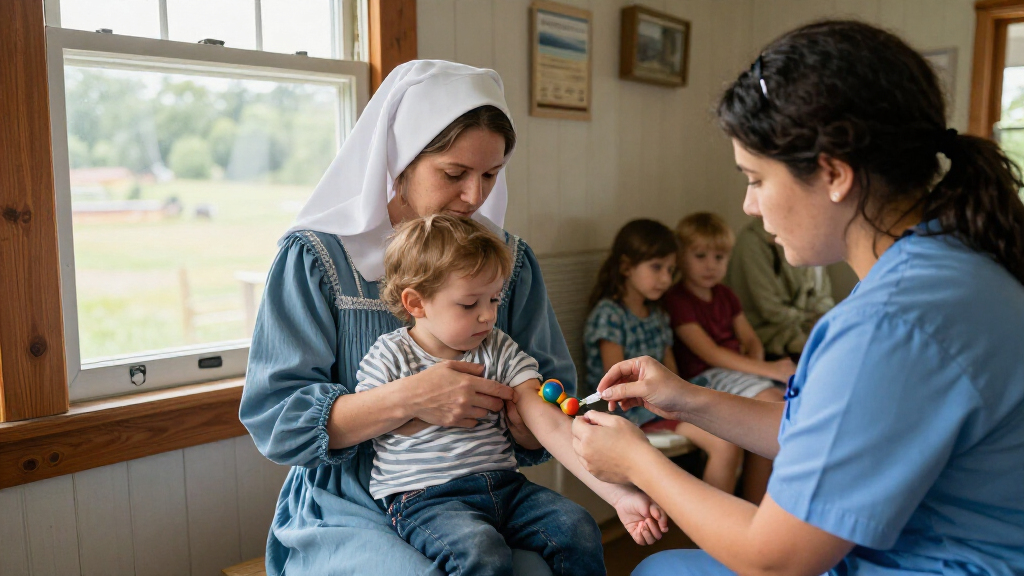
Union Community Care, a nonprofit with clinics in Lancaster and nearby towns, has held small vaccine clinics aimed at Plain communities, including Amish and conservative Mennonite residents. The clinics have administered about 450 measles shots, the organization’s chief medical officer, Anne-Marie Derrico, told MedPage Today. Union has also offered measles, mumps and rubella (MMR) vaccination to infants earlier than the routine schedule, following health experts’ advice for areas experiencing outbreaks.
Reports from the community show that attitudes are not uniform. One farmer said he decided to get vaccinated after adult siblings became ill, while Amish farmer Ephraim Zook said he continued to oppose vaccination after he and his wife cared for their young twins during measles. A Mennonite market vendor told the publication that his largely vaccinated community had not had infections.
Community leaders and experts told MedPage Today that low vaccination rates often reflect habit and limited prior use of vaccines, rather than a formal religious objection. Allen Hoover, an Old Order Mennonite and former administrator of a local medical center, said the main explanation he heard was, “Well, we never did before, and we came through all right.”
Outbreak Crosses Community Lines
The outbreak matters beyond Amish and Mennonite communities because residents regularly share schools, shops, markets, health services and other public spaces with the wider population. Lancaster County’s Amish residents are part of a county of roughly half a million people, where farms and suburban neighborhoods meet. Medical officials say the connections mean infection cannot be treated as confined to one community.
“There’s no way to imagine that this is going to be an isolated community,” Derrico told MedPage Today. She said Plain-community patients travel to the city and that people who are not vaccinated also attend schools and programs alongside other children. The reported rise in willingness to get shots could help limit transmission, but it does not establish how many residents remain unvaccinated or how much the clinics have changed the outbreak’s course.
Measles is highly contagious and can cause serious complications, including pneumonia and encephalitis, although many cases are mild. The state has recorded three measles-associated deaths in Lancaster County and two elsewhere in Pennsylvania, according to the report. Community leaders say official case totals may undercount infections because some people with measles do not seek medical care.
Products Worth Considering

Hyperice Normatec 3 Leg Compression Boots – Standard Size

Oura Ring 5 Smart Ring, Silver, Size 7

Oura Ring 4 Smart Ring – Silver – Size 8
As an affiliate, we earn on qualifying purchases.
Why Vaccine Views Differ
Vaccination rates and opinions vary among Amish and conservative Mennonite groups. The report describes rates as generally lower than in the wider population, while stressing that Plain communities are not uniform. Community leaders and researchers told MedPage Today that vaccine attitudes have shifted over time, including a decline in trust following strict COVID-19 public health measures. The current measles outbreak appears to be leading some people toward vaccination while reinforcing doubts for others.
Steve Nolt, director of the Young Center for Anabaptist and Pietist Studies at Elizabethtown College, told MedPage Today that wider Amish leadership has not framed vaccination as a religious issue. The report also notes a separate legal dispute: a cluster of Amish schools and individuals in New York is asking the U.S. Supreme Court to require that state to permit religious exemptions to school vaccine requirements. That case is distinct from Pennsylvania’s outbreak and does not establish a single position across Amish communities.
Public health outreach depends in part on relationships built over time. Hoover told the publication that health workers are more effective when they encourage vaccination rather than pressuring people to accept it. He said building trust in Plain communities can take “Twenty years.”
“There’s no way to imagine that this is going to be an isolated community.”
— Anne-Marie Derrico, chief medical officer at Union Community Care
Case Counts And Uptake Remain Unclear
The state’s reported case count may not capture the full scale of the outbreak. Community leaders told MedPage Today that some people with measles never see a doctor, and the report gives no estimate of the number of unreported cases. It also does not provide a count of how many people in Plain communities remain unvaccinated or how vaccination levels have changed over the course of the outbreak.
Although Pennsylvania’s cases have declined from their September peak, it is not clear whether that decline will last. Some doctors expect cases could rise as winter brings more indoor gatherings. The source report does not provide a forecast, a new case total after the reported decline, or evidence that the approximately 450 shots administered by Union have measurably reduced transmission.
Winter Could Test The Decline
Health workers are continuing outreach and vaccination clinics, including earlier MMR doses for infants in outbreak areas. The next key indicator will be whether Pennsylvania’s case numbers keep falling as colder weather increases indoor contact, or begin rising again. Further state case updates and information from local clinics may clarify the outbreak’s direction and whether more residents are seeking vaccination.
For now, the available reporting points to both a change and a limit: some Plain-community members are reconsidering vaccination, but views remain mixed, and the overall effect on case totals is not yet known.
Key Questions
How many measles cases has Pennsylvania reported?
Pennsylvania has recorded more than 1,350 cases in 2026, according to state figures cited by MedPage Today. More than a third were in Lancaster County. Community leaders say the reported total may be an undercount because some people with measles do not seek medical care.
Are Amish and Mennonite residents becoming more open to measles vaccines?
Some are, according to local health workers and community members interviewed by MedPage Today. Others remain opposed or uncertain; attitudes vary among Plain communities and individuals.
How many measles shots have local clinics given?
Union Community Care reported administering about 450 measles shots through small-scale clinics reaching Plain communities. The report does not establish how much those vaccinations have affected transmission.
Could measles cases rise again in Pennsylvania?
Cases have declined from a September peak, but some doctors cited in the report expect winter indoor gatherings could contribute to a rise. Whether that happens remains unclear.
Source: medpagetoday.com